Opening the book…
Learning Objective
- use heats of hydrogenation to compare the stabilities of alkenes
Heats of Hydrogenation
The stability of an alkene can be determined by measuring the amount of energy associated with the hydrogenation of the molecule. Since the double bond is breaking in this reaction, the energy released in hydrogenation is proportional to the energy in the double bond of the molecule. This is a useful tool because heats of hydrogenation can be measured very accurately. The \(\Delta H^o\) is usually around -30 kcal/mol for alkenes. Stability is simply a measure of energy. Lower energy molecules are more stable than higher energy molecules. More substituted alkenes are more stable than less substituted ones due to hyperconjugation. They have a lower heat of hydrogenation. The following illustrates stability of alkenes with various substituents:
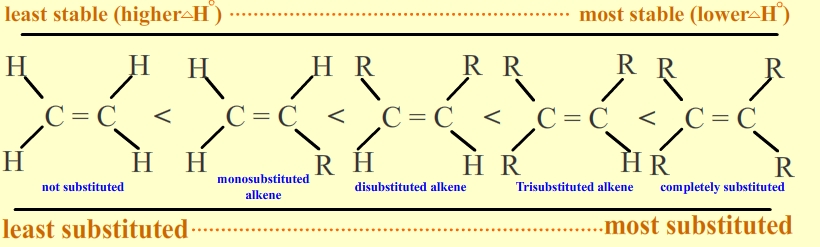
In disubstituted alkenes, trans isomers are more stable than cis isomers due to steric hindrance. Also, internal alkenes are more stable than terminal ones. See the following isomers of butene:

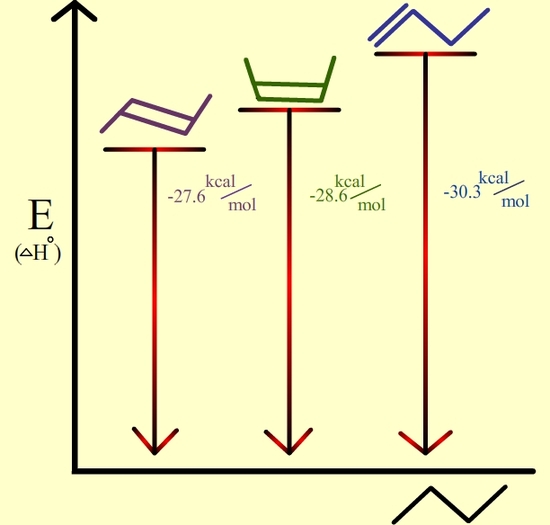
In cycloalkenes smaller than cyclooctene, the cis isomers are more stable than the trans as a result of ring strain.
Exercises
- When looking at their heats of hydrogenation, is the cis or the trans isomer generally more stable?
- Arrange the following alkenes in order of increasing stability: 2,3-dimethyl-2-butene; trans-2-hexene; 2-methyl-2-pentene; cis-2-hexene
- Which is the more stable alkene in each pair?
- Answer
-
1. Trans alkenes are more stable as demonstrated by the lower heats of hydrogenation when compared to their cis-isomers.
2. (least substituted and cis) cis-2-hexene < trans-2-hexene < 2-methyl-2-pentene < 2,3-dimethyl-2-butene (most substituted)
3. A) 2 b/c trans with same substitution at C=C B) 1 b/c the C=C is more substituted
References
- Fox, Marye Anne, and James K. Whitesell. Organic Chemistry. 3rd ed. Sudbury, MA: Janes and Bartlett Publishers, 2004.
- Hanson, James R. Functional Group Chemistry. Bristol, UK: The Royal Society of Chemistry, 2001.
- Streitwieser, Andrew Jr., and Clayton H. Heathcock. Introduction to Organic Chemistry. 2nd ed. New York, NY: Macmillan Publishing Co., Inc., 1981.
- Vollhardt, Peter C., and Neil E. Schore. Organic Chemistry: Structure and Function. 5th ed. New York, NY: W.H. Freeman and Company, 2007.
- Zlatkis, Albert, Eberhard Breitmaier, and Gunther Jung. A Concise Introduction to Organic Chemistry. New York: McGraw-Hill Book Company, 1973.
Contributors and Attributions
- Anna Manis (UCD)
Dr. Dietmar Kennepohl FCIC (Professor of Chemistry, Athabasca University)
Prof. Steven Farmer (Sonoma State University)
8.6: Stability of Alkenes is shared under a CC BY-NC-SA 4.0 license and was authored, remixed, and/or curated by LibreTexts.
The book could not be loaded just now.