Opening the book…
This textbook has been updated to a new edition and can be found here.
Clearly the adiabatic approximation has significant limitations in the vicinity of curve crossings. This phenomenon is better described through transitions between diabatic surfaces. To begin, how do we link the temporal and spatial variables in the curve crossing picture? We need a time-rate of change of the energy splitting, \(\dot {E} = d E _ {a b} / d t\). The Landau–Zener expression gives the transition probabilities as a result of propagating through the crossing between diabatic surfaces at a constant \(\dot {E} \). If the energy splitting between states varies linearly in time near the crossing point, then setting the crossing point to \(t = 0\) we write
\[E _ {a} - E _ {b} = \dot {E} t \label{5.30}\]
If the coupling between surfaces \(V_{ab}\) is constant, the transition probability for crossing from surface \(a\) to \(b\) for a trajectory that passes through the crossing is
\[P _ {b a} = 1 - \exp \left[ - \frac {2 \pi V _ {a b}^{2}} {\hbar | \dot {E} |} \right] \label{5.31}\]
and \(P _ {a a} = 1 - P _ {b a}\). Note if \(V_{ab} =0\) then \(P_{ba} =0\), but if the splitting sweep rate \(\dot {E} \) is small as determined by
\[2 \pi V _ {a b}^{2} \gg \hbar | \dot {E} |\label{5.32}\]
then we obtain the result expected for the adiabatic dynamics \(P _ {b a} \approx 1\).
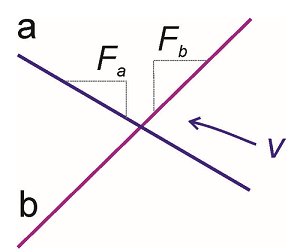
We can provide a classical interpretation to Equation \ref{5.31} by equating \(\dot {E} \) with the velocity of particles involved in the crossing. We define the velocity as
\[v = \dfrac{\partial R}{\partial t}\]
and the slope of the diabatic surfaces at the crossing,
\[F _ {i} = \partial E _ {i} / \partial R.\]
Recognizing
\[\left( E _ {a} - E _ {b} \right) / t = v \left( F _ {a} - F _ {b} \right) \label{5.33}\]
we find
\[P _ {b a} = 1 - \exp \left[ - \frac {2 \pi V _ {a b}^{2}} {\hbar v \left| F _ {a} - F _ {b} \right|} \right] \label{5.34}\]
In the context of potential energy surfaces, what this approximation says is that you need to know the slopes of the potentials at their crossing point, the coupling and their relative velocity in order to extract the rates of chemical reactions.
Readings
- Truhlar, D. D., Potential Energy Surfaces. In The Encyclopedia of Physical Science and Technology, 3rd ed.; Meyers, R. A., Ed. Academic Press: New York, 2001; Vol. 13, pp 9-17.
- Tully, J. C., Nonadiabatic Dynamics Theory. J. Chem. Phys. 2012, 137, 22A301.
This page titled 6.5: Landau–Zener Transition Probability was last modified on Sun, 16 Aug 2026 23:52:41 GMT and is shared under a CC BY-NC-SA 4.0 license and was authored, remixed, and/or curated by Andrei Tokmakoff via source content that was edited to the style and standards of the LibreTexts platform.
The book could not be loaded just now.