Opening the book…
From a Journey Map to a Conversion Path
A journey map is a visual representation of the journey of consumers, which brings a rather abstract way of understanding how consumers purchase products (e.g., awareness, consideration, purchase, and loyalty) to something concrete, with specific actions and touchpoints, that a brand can use to create a marketing strategy.
A conversion path is how a brand is thinking of enacting this strategy. It ties together multiple tactical activities (e.g., search ad and content marketing). It can be defined as a description of the steps that a company wants consumers to take to achieve a desired goal. In the digital vocabulary, a conversion occurs when a consumer has achieved a goal you wanted them to achieve. Goals are widely varied: it can be visiting a page, clicking on a link, sending you their email address, buying a product, spending more than a specific amount of time on one of your pages, viewing a certain number of pages during a session, using a key feature, and the list goes on. To create a conversion path, companies pre-plan a set of steps they want consumers to take to achieve that goal. The shortest conversion path that is typically presented in digital marketing is ad to content to landing page (see below):

The planning steps consumers take to achieve what you want them to achieve is central to creating digital marketing campaigns. We do not simply create content and ads in the hopes that consumers will visit our website or click on our ads without any idea of what will happen next. Rather, the best-strategize campaigns always answer the question, "What comes next?" For example, if you’re creating an ad to appear at the top of a SERP, what comes next? What are you expecting people to do? Where are you leading them? What should they be doing once they get on this page? Why? Answering these questions is how you can create highly-converting campaigns because you have a clear idea of the goal consumers should achieve, and you can, therefore, create pages and ads that will lead them to achieve these goals.
Depending on who you ask, it takes between 5 and 13 touchpoints (or interactions with your brand) to generate a qualified, sales-ready lead (Glynn, 2015; Beasley, 2013). We will come back to the notion of qualified lead (i.e., a lead that you believe can be your customer) and sales-ready (i.e., a lead that is at the purchase stage) later during the semester. For this chapter, what is important to understand is that, without planning in advance what these 5 to 13 touchpoints will be, it will be quite difficult to create sales. The task of a digital marketer is thus understanding how to bring people through a set of smaller goals, like visiting a blog post, spending 3 minutes reading the post, giving the company an email address, opening the first email (and so on), that will lead them to achieve certain milestones towards making a purchase. Otherwise, a company will be flying in the dark, with no clear strategy for making sales apart from putting ads online and creating content.
For your term project, your goal is to create a clear conversion path composed of three inbound and three outbound marketing activities. They can be part of the same path (see Figure 14.7) or part of different paths (see Figure 14.8), but you need to think ahead of a set of tactics and associated marketing activities that are clearly linked to make people "walk" through the path you’ll have created for them. Ideally, your path should indicate what you are doing (i.e., your tactic) and what you expect consumers to do (i.e., a goal).
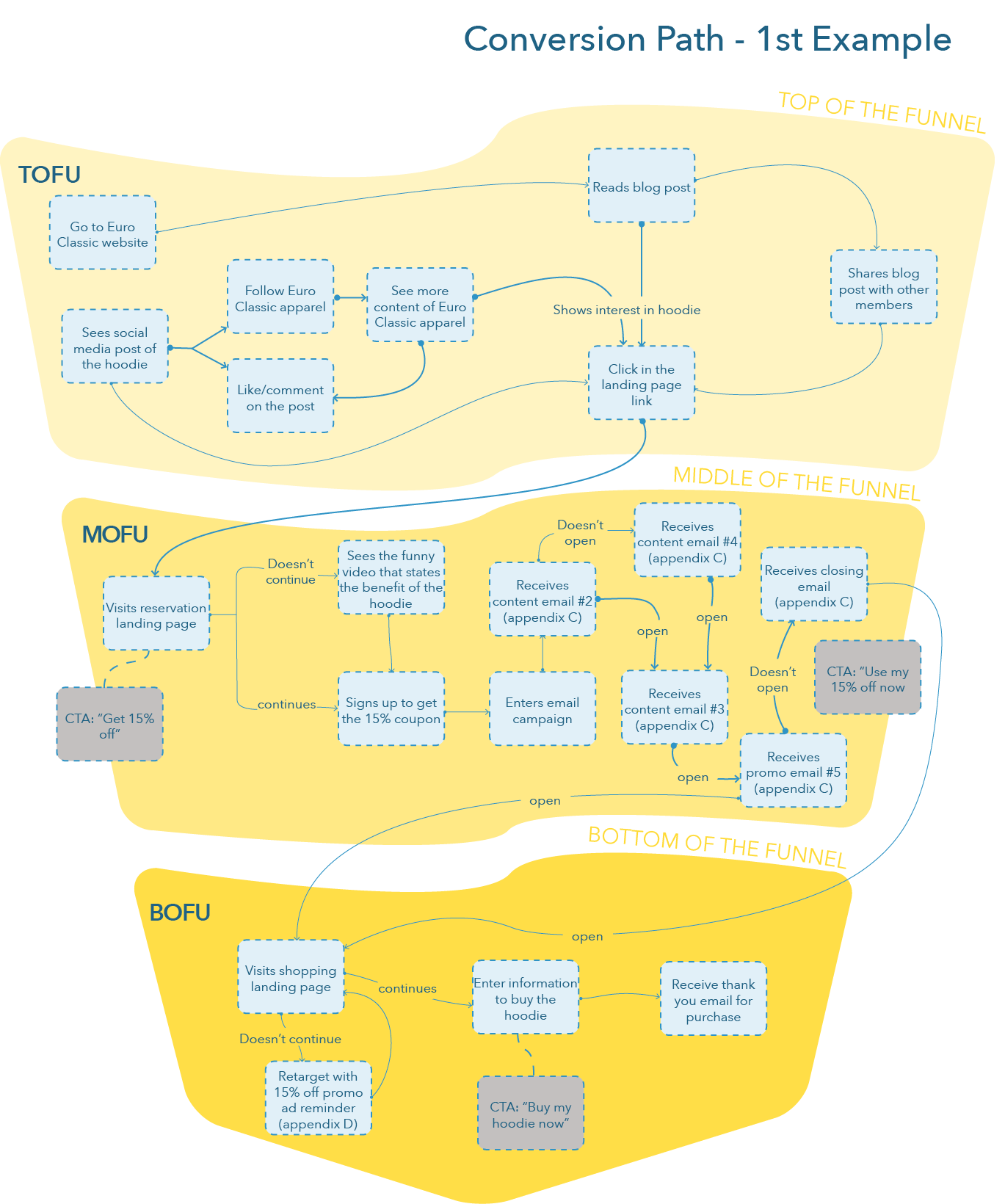

14.7: From a Journey Map to a Conversion Path is shared under a CC BY 4.0 license and was authored, remixed, and/or curated by LibreTexts.
The book could not be loaded just now.