Opening the book…
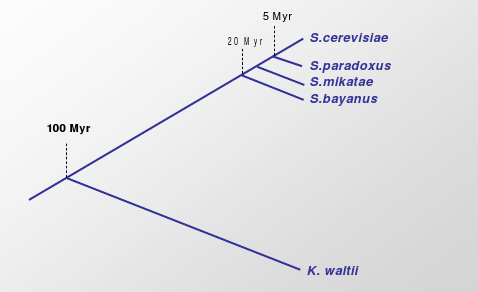
Figure 5.24: Moving further back in evolutionary time for Saccharomyces.
As you trace species further back in evolutionary time, you have the ability to ask different sets of questions. In class, the example used was K. waltii, which dates to about 95 millions years earlier than S.cerevisiae and 80 million years earlier than S.bayanus.
Looking at the dotplot of S.cerevisiae chromosomes and K.waltii scaffolds, a divergence was noted along the diagonal in the middle of the plot, whereas most pairs of conserved region exhibit a dot plot with a clear and straight diagonal. Viewing the segment at a higher magnification (Figure 5.25), it seems that S.cerevisiae sister fragments all map to corresponding K.waltii scaffolds.
Schematically (Figure 5.26) sister regions show gene interleaving. In duplicate mapping of centromeres, sister regions can be recognized based on gene order. This observed gene interleaving provides evidence of complete genome duplication.
This page titled 5.7: Whole Genome Duplication was last modified on Sun, 03 Jan 2021 23:16:10 GMT and is shared under a CC BY-NC-SA 4.0 license and was authored, remixed, and/or curated by Manolis Kellis et al. (MIT OpenCourseWare) via source content that was edited to the style and standards of the LibreTexts platform.
The book could not be loaded just now.