Opening the book…
Imagine that you could identify and quantify every molecule within a cell (Figure \(\PageIndex{1}\)) in a single assay. You could use this ability to better understand almost any aspect of biology. For example, by comparing the molecular profiles of plants that differed in their resistance to drought, you might discover which combination of genes or proteins makes a crop drought tolerant. Although it is not currently possible to study literally every molecule in a cell in a single experiment, recent advances in molecular biology have made it possible to study many genes (or their products) in parallel.
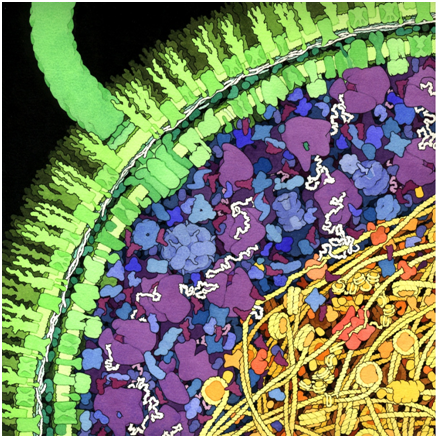
Figure \(\PageIndex{1}\): An artist’s depiction of part of an E.coli cell, showing many different types of molecules in their typical abundance. mRNA appears as white lines associated with purple ribosomes, while DNA and proteins such as histones are yellow. (Goodsell, Scripps-EDU)
This page titled 11: Genomics and Systems Biology was last modified on Tue, 20 Jun 2023 04:33:08 GMT and is shared under a CC BY-SA 3.0 license and was authored, remixed, and/or curated by Todd Nickle and Isabelle Barrette-Ng via source content that was edited to the style and standards of the LibreTexts platform.
The book could not be loaded just now.