Opening the book…
Search Fundamentals of Biochemistry
(Learning goals written by Claude, Sonnet 4.6, Anthropic)
Metabolic Shunts and Bypasses of the Citric Acid Cycle
- Explain the metabolic logic of the glyoxylate shunt — including the reactions catalyzed by isocitrate lyase and malate synthase, the net equation consuming two acetyl-CoA and producing one succinate, and why this shunt allows organisms to synthesize carbohydrates from acetate in a net fashion while the standard citric acid cycle cannot.
- Describe the GABA shunt in neural tissue, explaining how glutamate decarboxylation produces the inhibitory neurotransmitter GABA, how GABA aminotransferase activity is regulated by α-ketoglutarate availability to conserve GABA levels, and how the shunt allows glutamate to enter the citric acid cycle — connecting this to the therapeutic use of GABA aminotransferase inhibitors in epilepsy.
- Describe how cyanobacteria circumvent the absence of α-ketoglutarate dehydrogenase by using a two-enzyme bypass (α-ketoglutarate decarboxylase and succinic semialdehyde dehydrogenase) and the GABA shunt, and explain why understanding such variants is relevant to the biology of these ecologically critical organisms.
Reductive and Cancer-Related Variants of the Cycle
- Explain how cancer cells exploit reductive carboxylation — using IDH2 in reverse to convert α-ketoglutarate to isocitrate and then to citrate — to replenish citrate for fatty acid synthesis when mitochondrial oxidative function is compromised, and describe the role of nicotinamide nucleotide transhydrogenase in supplying the NADPH required for this reductive pathway.
- Explain why acetyl-CoA cannot produce a net increase in oxaloacetate or glucose through the standard citric acid cycle, and contrast this with the glyoxylate shunt in which net gluconeogenic precursors are generated — connecting this distinction to the evolutionary and ecological significance of the shunt in bacteria and plants.
Evolution and Diversity of the Citric Acid Cycle
- Describe the major variations of the citric acid cycle found across organisms — including differences in cofactor specificity (NAD⁺ vs. NADP⁺ for isocitrate dehydrogenase), nucleotide substrate specificity for succinyl-CoA synthetase, and the prevalence of incomplete cycles in bacteria — and explain the evolutionary interpretation that the cycle likely originated from two separate linear pathways (an oxidative arm to α-ketoglutarate and a reductive arm to succinyl-CoA).
- Describe the proposed prebiotic α-ketoacid pathway in which glyoxylate and pyruvate react under mild aqueous conditions without enzymes or metals to form TCA-like α-ketoacids in a reductive, counterclockwise direction, and explain why the absence of decarboxylation steps in this abiotic pathway suggests that decarboxylation reactions required biological catalysts for their evolution.
Evolution has enabled variants in the citric acid cycle to confer new functions in organisms. Let's consider a few shunts and bypasses.
Glyoxylate Shunt
What if you were a microorganism that has evolved to use acetate (2C) as a source (if not the sole source) of energy? Remember that the citric acid cycle also generates metabolites for anaplerotic reactions (from the Greek ἀνά = 'up' and πληρόω = 'to fill'). In the full citric acid cycle, activated acetate (2C) reacts with oxaloacetate (4) to produce the 6C molecule citric acid. As the cycle continues back to oxaloacetate, 2 Cs are lost as CO2, so in sum for one turn of the cycle:
oxaloacetate (4C) + acetyl-CoA (2C) → Citrate (6C) → → → succinate (4C) + 2 CO2 (2C).
During this process, oxidation reactions occur, producing NADH and FADH2. The metabolites formed can be utilized for biosynthesis (OAA, α-KG, and succinyl-CoA).
An alternative "cycle" would be to eliminate the two decarboxylation reactions and generate a 4C molecule (succinate) and one 2C metabolite (glyoxylate), which could react with another activated acetate (acetyl-CoA) to form oxaloacetate (or, more precisely, malate, which can be oxidized to it). Hence, two acetates are required; however, if you are an organism adapted to utilize this as a metabolic energy source, it's no problem. Here is the next reaction
oxaloacetate (4C) + acetyl-CoA (2C) → Citrate (6C) → → succinate (4C) + glyoxylate (2C);
glyoxylate (2C) + acetyl-CoA (2C) → malate (4C )
This reaction would act as a metabolic shunt, altering metabolite flow by bypassing part of the citric acid cycle. The shunt, which is found in many microorganisms and some plants, is called the glyoxylate shunt, which is shown in Figure \(\PageIndex{1}\).

Why is this so cool? First, consider this observation about the citric acid cycle. One acetate, in the form of acetyl-CoA, is needed to form one oxaloacetate in one turn of the cycle, which is needed for another turn of the cycle. Hence, acetyl-CoA cannot, in a net fashion, be used to synthesize oxaloacetate. We previously observed that oxalate is an intermediate in the synthesis of phosphoenolpyruvate from pyruvate during gluconeogenesis. Hence, acetate can not be used to form glucose in a net fashion. (Note: pyruvate dehydrogenase is not reversible). Another way to think about this is that 2Cs enter the cycle as acetyl-CoA and two leave as CO2, so that no net synthesis can occur. And you are in trouble if you draw off oxaloacetate, as well as α-ketoglutarate and succinate, for anaplerotic reactions in biosynthesis, as they are needed metabolites for a cycle that consumes and produces one of each, and will be depleted if withdrawn.
Now, you have no worries if you are an organism (many bacteria and plants) with the glyoxylate shunt. A mini cycle still occurs when isocitrate is converted to glyoxylate, then to malate, and back to oxaloacetate and citrate (for energy production), with the net output of 1 succinate (for biosynthesis). The only carbon atoms "lost" from the mini cycle are in the form of succinate, so they are not lost as the two CO2s in the citric acid cycle, since they are used for biosynthesis.
The next reaction for the glyoxylate cycle is:
2 Acetyl-CoA + 2 NAD+ + 2 H2O → 2 succinate + 2 NADH + 2 CoASH + 2 H+ .
In plants, this reaction occurs in organelles called Glyoxysomes. Succinate can be converted to oxaloacetate via the citric acid cycle, which can then be converted to glucose and other carbohydrates through gluconeogenesis. Hence, organisms with the glyoxylate shunt (or cycle) can synthesize carbohydrates in a net fashion from acetate, which can be derived from fatty acid degradation, as we will see in a subsequent chapter.
To operate the glyoxylate cycle efficiently, you need to activate the carboxyl end of acetate. Plants and other organisms that can grow on acetate can produce acetyl-CoA needed for the above pathways from the following reaction, catalyzed by acetyl-CoA synthase (i.e., not pyruvate dehydrogenase)
Acetate + CoASH + ATP → Acetyl-CoA + AMP + PPi
Note that one phosphoanhydride bond is cleaved, and one thioester bond is formed. These molecules are both high-energy compared to their hydrolysis products, so this reaction alone is not thermodynamically favored in any significant way (remember that there is no such thing as a high-energy bond). The hydrolysis of pyrophosphate (PPi) drives this reaction forward. An analogous reaction drives peptide bond formation in proteins, as it also uses ATP to form an activated mixed anhydride from the free carboxyl group.
GABA Shunt
Now, let's move to the brain, where there is a lot of chemistry happening as you read this page. Neural function requires relatively high concentrations of key neurotransmitters, which must be maintained against metabolic losses. Glutamate is the principal excitatory neurotransmitter, and GABA (δ-aminobutryic acid) is the principal inhibitory neurotransmitter. Both are maintained at high concentrations and are principal players in the GABA shunt. Figure \(\PageIndex{2}\) shows a part of the large pathway shown above, but in a more expanded form.
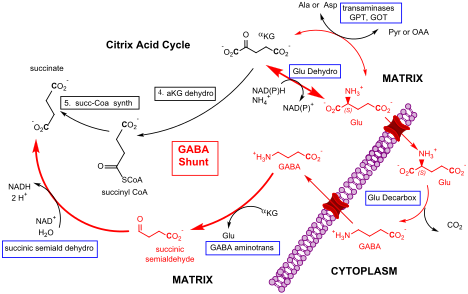
GABA is formed in the cytoplasm by decarboxylation of Glu by the enzyme glutamate decarboxylase, which appears to be expressed predominantly in neural tissue. It is metabolized by GABA transaminase but only if the compound from which the shunt starts, α-ketoglutarate, is present abundantly. This conserves the neuron's GABA supply. Stated in another way, the breakdown product of GABA, succinic semialdehyde, is formed only if GABA's precursor is present. Inhibitors of GABA aminotransferase are used to treat epilepsy. Another function of the shunt is to allow glutamate to loop into the cycle effectively.
α-ketoglutarate ↔ Succinate Bypass
In anticipation of the section below, one could ask, what happens when a step in the cycle is impaired or missing? Cyanobacteria, a key player in atmospheric O2 production and the drawdown of natural and anthropogenic atmospheric CO2, were thought to have an incomplete citric acid cycle because they lack α-ketoglutarate dehydrogenase. They circumvent this issue by directly converting α-ketoglutarate to succinate via two enzymes: α-ketoglutarate decarboxylase and succinic semialdehyde dehydrogenase, as illustrated below. The first enzyme catalyzes a non-oxidative decarboxylation of the substrate to succinic semialdehyde. This bypass is shown in Figure \(\PageIndex{3}\). Additionally, cyanobacteria utilize the GABA shunt as a bypass for α-ketoglutarate dehydrogenase.
 Figure \(\PageIndex{3}\): α-ketoglutarate to succinate bypass. (Copyright; author via source)
Here is yet another example. Each member of the cycle is crucial. Consider the first one: citrate. It is formed in the key step that couples the output of anaerobic glucose metabolism, pyruvate, with the formation of citrate in the citric acid cycle. What happens if aerobic metabolism is impaired, as it would be in hypoxic and anoxic conditions, or if mitochondrial function is compromised, or in disease states such as cancer? Is there an alternative way to form citrate? Turns out that there is. And it centers on α-ketoglutarate again. The figure above illustrates this.
Let's consider cancer, characterized by rapid cell proliferation. This requires energy and metabolic precursors to synthesize carbohydrates, lipids, and proteins. The citric acid cycle offers both. To accommodate this demand for the withdrawal of citric acid cycle intermediates for reductive biosynthesis, large fluxes of glutamate (derived from abundant glutamine) enter the cycle as α-ketoglutarate. In another anaplerotic reaction, citrate lyase cleaves citrate to form acetyl-CoA, which rapidly proliferating cells use for fatty acid synthesis. To replenish citrate, cancer cells convert α-ketoglutarate to isocitrate via reductive carboxylation, a process facilitated by isocitrate dehydrogenase 2, which uses NADPH for the reduction. That NADPH comes from the enzyme nicotinamide nucleotide transhydrogenase, which can interconvert matrix pools of NADH and NADPH using the collapse of a protein gradient across the mitochondria's inner membrane (which we will study in a subsequent chapter).
H+(in) + NAD+ + NADPH ↔ H+(out) + NADH + NADP+
This process occurs in both oxidative (α-ketoglutarate to succinyl-CoA) and reductive (α-ketoglutarate to isocitrate) reactions.
Variants of the TCA Cycle in Microorganisms
It's easy to be anthropocentric when writing a biochemistry text, since many students take the course because they're interested in human medicine. Since humans are an ecosystem of organisms with an expansive microbiome on their skin and in their gut, it's important to compare the same pathway across different organisms, even from a human health perspective. It's also important to understand our role as a small part of a vast biosphere where our survival depends on other organisms, large and small.
In that light, let's consider the citric acid cycle of other organisms. It seems that almost all organisms have the universal anaerobic glycolytic pathway. How about the aerobic citric acid cycle? Today, single-cell genomic analysis makes it possible to analyze citric acid cycle genes in any organism. Variants of it are found in almost all aerobic organisms, as well as in some anaerobic ones. Some subtle differences exist between eukaryotic and prokaryotic organisms. NAD+ is used as a substrate in the mammalian form of isocitrate dehydrogenase, while prokaryotes use NADP+. In mammals, an NAD+-dependent malate dehydrogenase is utilized, whereas some prokaryotes employ a different enzyme, a NADP+-dependent malate-quinone oxidoreductase. Lastly, different enzymes (and, unfortunately, with varying names) convert succinyl-CoA to succinate. Plants and fungi use ADP as a substrate; mammals have two enzymes, often named differently for the reverse reaction: succinate-CoA ligase (ADP-forming) and succinate-CoA ligase (GDP-forming).
Analyses have shown that few bacteria have complete cycles. Of those with incomplete cycles, the early steps are least conserved, while the latter are most conserved. The cycle is used for oxidative energy production and to generate metabolites (α-ketoglutarate, oxaloacetate, and succinyl-CoA), which are pulled from the cycle for biosynthesis. Autotrophs without a complete cycle can make those products from pyruvate. Consider α-ketoglutarate. Some organisms carry out the clockwise oxidative reaction from citrate to α-ketoglutarate, whereas some methanogenic Archaea undergo counterclockwise reduction reactions. Comparative genomic analyses suggest that the citric acid cycle likely evolved from "linear" oxidative pathways leading to α-ketoglutarate and a reductive pathway leading to succinyl-CoA. Understanding the pathways in individual microorganisms can aid in the rational design of new antibiotics. Figure \(\PageIndex{4}\)below, adapted from Huynen et al., shows a geometric analysis diagram of the citric acid cycle and variants in other organisms.

The α-ketoacid pathway - A primordial, prebiotic anabolic "TCA-like" pathway
After studying the complexity of pyruvate dehydrogenase and the citric acid cycle, you might wonder how the cycle might have originated. As discussed above, clues are derived from comparative genome analysis of genes encoding enzymes for the reactions in many organisms. Examining evolutionary changes in genes and functions underlying these reactions provides insight into the earliest enzymes to evolve in the pathway. But what about an abiotic pathway that might have arisen before the first biological one? Stubbs et al. have demonstrated that the elementary molecules glyoxylate and pyruvate can react under mild aqueous conditions (pH 7 in 0.5 M phosphate buffer, heated to 50 °C) to form, in a single pot, α-ketoacids similar to those present in the citric acid cycle. From a kinetic perspective, they were formed in the reverse, counterclockwise reductive direction, rather than in the citric acid cycle (clockwise, oxidative). No metals or "enzymes" were needed for the transformations. Glyoxylate acts as a reducing agent and also provides the carbon atoms. Once these α-ketoacids form, they could be theoretically converted by transamination reactions to amino acids, as they should be characterized by a Keq ≈1 and a ΔG0 ≈ 0.
The citric acid cycle contains many carboxylic acids. Only the α-ketoacids (α-ketoglutarate and oxaloacetate) can readily form carbanions at the alpha carbons as their Hs are slightly acidic due to resonance stabilization of the carbanion through an enolate tautomer. The others are electron-rich, so their alpha carbons are less acidic, which discourages deprotonation without harsh catalysts. So perhaps abiotic precursors contained alternative functional groups. Perhaps they contained α-ketoacids similar to α-ketoglutarate, oxaloacetate, and, of course, pyruvate. In addition, α-ketoacids have an electrophile in the form of the carbonyl carbon for C-C bond formation.
Figure \(\PageIndex{5}\) shows the reductive, counter-clockwise pathway (Stubbs et al.). Note that in both the glyoxylate "cycle," which has also been proposed as an abiotic pathway, and the α-ketoacid reductive pathway, no CO2 is lost in any step. This suggests that, although the decarboxylation steps are often thermodynamically favored, catalysts are required to facilitate the process. The two α-ketoacids substrates in this pathway, glyoxylate (2Cs) and pyruvate (3Cs), are the smallest and most likely formed acids.
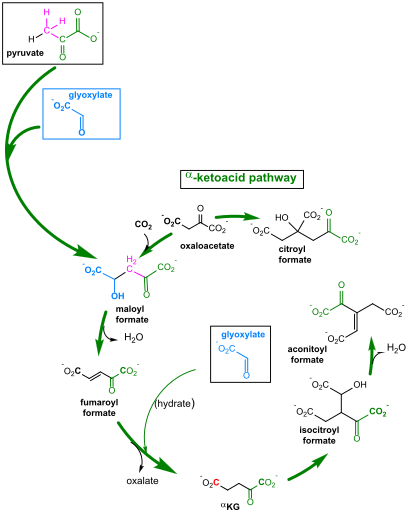
Figure \(\PageIndex{6}\) is an animation that shows the entire citric acid cycle (catabolic, oxidative, running clockwise), the glyoxylate shunt, which bypasses many steps in the citric acid cycle, and the proposed prebiotic anabolic alpha-ketoacid pathway (bold green arrows), which essentially runs counterclockwise and is reductive.

Summary
(Summary written by Claude, Sonnet 4.6, Anthropic)
This chapter extends the description of the citric acid cycle beyond its canonical form to explore metabolic shunts, reductive variants, cancer-associated rewiring, and evolutionary origins, illustrating that the cycle is not a fixed biochemical circuit but a flexible metabolic hub whose architecture has been extensively modified across the history of life.
The glyoxylate shunt is the most biochemically significant departure from the standard cycle, enabling organisms such as bacteria, fungi, and plants to grow on acetate as a sole carbon source. The fundamental problem it solves is this: in the standard citric acid cycle, the two carbons entering as acetyl-CoA are exactly balanced by the two carbons lost as CO₂, so no net synthesis of oxaloacetate or gluconeogenic precursors can occur. The glyoxylate shunt bypasses the two oxidative decarboxylation steps by introducing two unique enzymes: isocitrate lyase, which cleaves isocitrate into succinate and the two-carbon compound glyoxylate, and malate synthase, which condenses glyoxylate with a second acetyl-CoA to form malate. The net result — two acetyl-CoA consumed per succinate produced — allows a net gain of four-carbon organic acids that can fuel gluconeogenesis through the standard cycle reactions. In plants, this occurs in specialized organelles called glyoxysomes. The ecological significance is considerable: organisms with the glyoxylate shunt can convert the products of fatty acid degradation (as acetyl-CoA) into carbohydrates, a metabolic capability that mammals, which lack the shunt enzymes, do not possess.
The GABA shunt operates in neural tissue and sits at the intersection of neurotransmitter metabolism and the citric acid cycle. Glutamate — the principal excitatory neurotransmitter — is decarboxylated by glutamate decarboxylase to produce GABA, the principal inhibitory neurotransmitter. GABA is metabolized by GABA aminotransferase only when its precursor, α-ketoglutarate, is abundant; this substrate dependence conserves GABA when α-ketoglutarate is depleted, providing a self-regulatory mechanism for maintaining inhibitory neurotransmitter levels. The succinic semialdehyde produced by GABA transamination is oxidized to succinate and re-enters the cycle. Inhibitors of GABA aminotransferase are used clinically to treat epilepsy by elevating synaptic GABA levels.
Cyanobacteria — the photosynthetic bacteria responsible for generating most of Earth's atmospheric oxygen and for fixing large quantities of CO₂ — were long thought to lack a complete citric acid cycle because they lack α-ketoglutarate dehydrogenase. Two bypass strategies compensate: a direct two-enzyme conversion of α-ketoglutarate to succinate via α-ketoglutarate decarboxylase (non-oxidative decarboxylation) and succinic semialdehyde dehydrogenase, and the GABA shunt described above.
Cancer cells provide a striking example of reductive cycle rewiring. Rapidly proliferating tumor cells require both ATP and biosynthetic precursors, including acetyl-CoA for fatty acid synthesis. Under hypoxic conditions or with compromised mitochondrial function, they use isocitrate dehydrogenase 2 (IDH2) in reverse — reductively carboxylating α-ketoglutarate (derived from glutamine via glutamate) to isocitrate, which is then isomerized to citrate. Citrate lyase then cleaves this cytoplasmic citrate to oxaloacetate and acetyl-CoA, fueling lipogenesis. The NADPH required for this reductive pathway is supplied by nicotinamide nucleotide transhydrogenase, which interconverts mitochondrial NADH and NADPH using the proton gradient across the inner mitochondrial membrane.
The chapter closes with an evolutionary perspective. Comparative genomics reveals that few bacteria possess a complete citric acid cycle; the early steps are least conserved, while the later steps (from succinyl-CoA to oxaloacetate) are most conserved across organisms. This pattern, combined with the observation that some organisms run the early portion of the cycle reductively (counterclockwise), suggests that the full oxidative cycle evolved by fusing two ancient linear pathways—an oxidative arm producing α-ketoglutarate and a reductive arm producing succinyl-CoA. At the most ancient level, Stubbs and colleagues demonstrated that glyoxylate and pyruvate react spontaneously under mild aqueous conditions (pH 7, 50°C, no enzymes or metals) to produce α-ketoacids chemically homologous to TCA cycle intermediates, proceeding in a reductive, counterclockwise direction. The absence of decarboxylation steps in this abiotic pathway implies that decarboxylation — now catalyzed by sophisticated enzyme complexes such as the pyruvate dehydrogenase and α-ketoglutarate dehydrogenase complexes — required biological catalysts to evolve and was not part of the earliest prebiotic chemistry. Once formed, these α-ketoacids could in principle be converted to amino acids by transamination reactions with Keq ≈ 1, suggesting a plausible pathway from simple abiotic chemistry to the first biosynthetic molecules of life.
This page titled 16.4: Variants of the Citric Acid Cycle was last modified on Mon, 14 Sep 2026 11:53:21 GMT and is shared under a not declared license and was authored, remixed, and/or curated by Henry Jakubowski and Patricia Flatt.
The book could not be loaded just now.