Opening the book…
Chapter Hook
Until the late 1800s, Bison (Bison bison) numbered tens of millions in the Great Plains of the United States. By 1890, roughly 1000 Bison were left because the United States government campaign to eradicate the native people, their culture, and habitats they relied on. Slowly, a movement started to try and save Bison from extinction. It took until the early 2000’s for Bison numbers to reach a half a million. During this time, scientists were able to observe the Bison reintroduction back into the Great Plains. Bison were found to be the most critical species to restoring and maintaining the function and diversity in the Great Plains community. Both plants and animal populations in the community were strengthened from the return of the Bison. Understanding community dynamics is essential to conserving and restoring these systems and the species that define them. This is particularly critical for communities with one particular species that acts as a keystone to the health of the system.
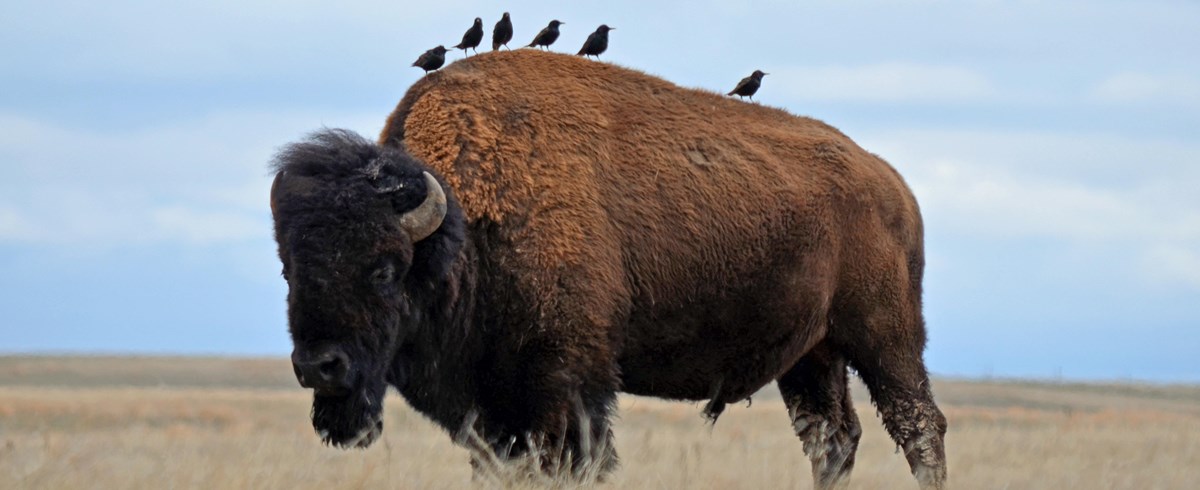
Figure \(\PageIndex{a}\): American bison with starlings on its back. Image by NPS photos/Kim Acker (Public Domain)
Populations typically do not live in isolation from other species. Populations that interact within a given area form a community. The organisms that form a community are found in habitats, physical environments where organisms live; however, biotic (living) components are considered part of a community. Scientists study ecology at the community level to understand how species interact with each other and compete for the same resources.
Attribution
Modified by Rachel Schleiger and Melissa Ha from Community Ecology from Environmental Biology by Matthew R. Fisher (licensed under CC-BY)
- 6.1: Biotic Interactions
- Biotic interactions describe the relationship between organisms. They may be intraspecific (within a species) or interspecific (between species). Antagonisms are interactions in which one or both organisms are harmed. In facilitation, at least one species benefits, and neither is harmed.
- 6.2: Community Structure and Dynamics
- Community structure refers to the species and their relative abundances in a community, and community dynamics describe how community structure changes over time. Keystone species can facilitate species diversity in a community. Communities change over time through the process of succession.
This page titled 6: Communities was last modified on Mon, 05 Sep 2022 19:40:36 GMT and is shared under a CC BY-NC 4.0 license and was authored, remixed, and/or curated by Melissa Ha and Rachel Schleiger (ASCCC Open Educational Resources Initiative) .
The book could not be loaded just now.