Opening the book…
Transplanting refers to moving of a plant from one location to another, but is often used to specifically refer to the moving of indoor-started seedlings into the garden or field. This is traumatic process for young seedlings and care must be given during the process. Plants should not be planted outdoors until air temperatures are sufficiently warm to support active growth. However, even if outdoor conditions are good for planting, the dramatic shift in environmental conditions can induce significant stress. To minimize this transitional stress, seedlings should be “hardened off” before planting. This process should be started about two weeks before expected planting date. First the young seedlings should be placed outside for several hours only, and then returned indoors. This is repeated 2-3 days followed by longer and longer exposure times. Finally, the last few days before planting the seedlings should be left completely outside. This allow time for physiological changes to occur that increase the seedlings likelihood of surviving. The leaf surface surfaces become tougher and more water-proofing is added to the leaf surfaces to prevent water loss. The stems stiffen and thicken to support the plant. Sunlight tolerance increases with increased chlorophyll (for greater photosynthetic activity) and carotenoids (protective pigments).
Preparation of the planting hole is important for encouraging proper root growth. The transplant hole should be wider but no deeper than the root ball or tray cell it has grown in. Backfill the hole with native soil or amended soil to cover the roots and firmed gently to set the transplant at the same depth it was growing previously. This should be done with minimum disturbance to the root ball. Some plants, like tomato plants, can be planted deeper if desired because the stems will produce adventitious roots to help with water and nutrient uptake. Space between plants will vary with species and cultivar. Small, fast-growing varieties can be planted closely together while plants that will grow larger will require proper spacing for future development. Tomato plant are typically planted 18 inches apart while basil plants can be planted 6-8 inches apart. A starter fertilizer solution can be applied at planting using water-soluble formulations or root-stimulating granular products worked into the backfill soil.
Regardless of the care taken when transplanting seedlings, some damage to the root system is unavoidable. The root hairs are responsible for most of the water and nutrient uptake by a plants root system. These delicate structures are simple extensions of epidermal cells and are easily destroyed. It is there for critical that regular irrigation occur during the establishment period as the root systems expands and the root hairs are replaced. For most crops this is about a two-week period. The use of organic mulch around transplants helps suppress weeds, conserve moisture and regulate soil temperatures. Placing protective floating row covers over transplants shields them from pests.
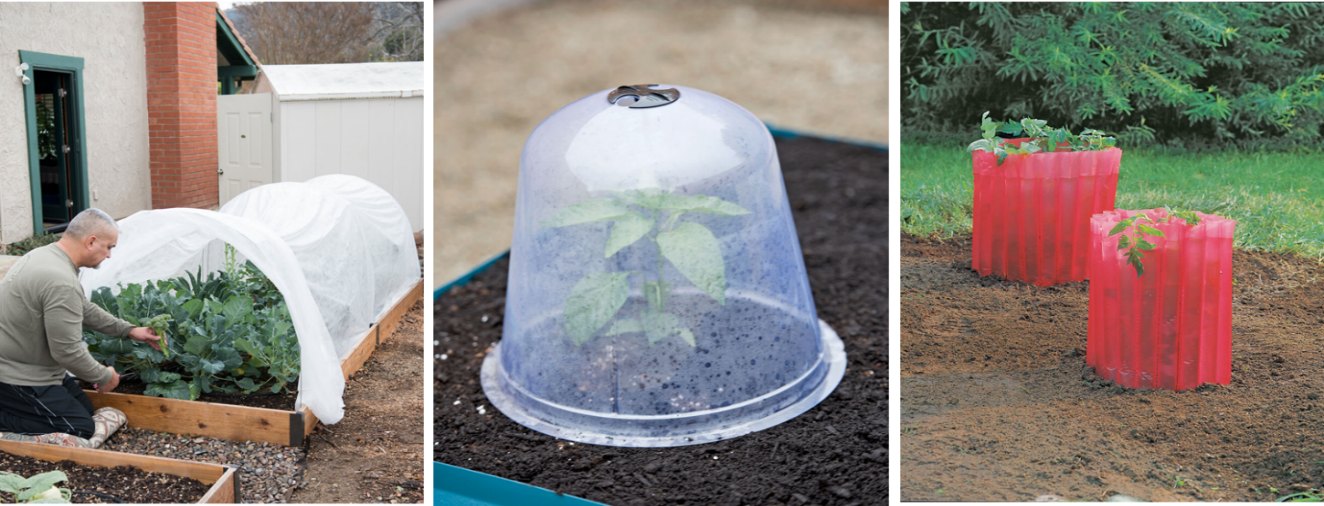
The threat of frost damage to cold-sensitive plants is a concern when transplanting early in the season. Spring night temperatures can be difficult to predict. If you have already put your transplants in the ground and then need to protect them for the cold, there are several options available. Fabrics (like bedsheets), paper or plastic sheeting can provide some level of protection from the cold atmospheric temperatures. The addition of soil mounds, walls of compost or grass clippings around transplants can hold heat and provide insulation. Commercial products like “low-tunnels”, “hot kaps” domes, cloches, and water teepees can purchase for use as well (Figure 9-16). Since water has a high thermal capacity filling plastic milk jugs or larger containers with hot water and placing them among the transplants will release warmth overnight. While these methods will provide so limited degrees of protection, transplant date selection based on the expected end of frost occurrence is more reliable for avoiding cold damage.
Using established transplants is helpful for ensuring plants have ample time to mature the desired amount before the end of the season. Starting seeds indoors allows earlier planting dates and monitoring growing conditions can encourage strong seedlings ready to withstand the transition outdoors. Careful attention to hardening off, proper planting procedures and frost protection where needed leads to higher success rates for establishing transplants in the landscape or garden.
This page titled 9.1.6: Transplanting was last modified on Sat, 14 Nov 2026 17:07:13 GMT and is shared under a CC BY-NC-SA 4.0 license and was authored, remixed, and/or curated by Stephanie Harvey.
The book could not be loaded just now.