Opening the book…
The seeds of some plants require being prepping before they will germinate. For some, seeds must be exposed to chilling or cold temperatures for a period of time before they will germinate. This process is called stratification. This is an evolutionary adaptation that helps ensure that the seeds will have the best conditions for germination and for the survival of the seeding. If a seed produced in late summer were to germinate just before a freeze occurred, the young tender tissues are unlikely to survive. Therefore, it is an evolutionary advantage that the seeds remain dormant until they have been exposed to cold temperatures for a period of time. Then, as the soil warms up in spring, germination is triggered. Plants that have evolved in areas with extremely long, cold winters need longer exposure times to cold to germinate in the spring, while plants that evolve in areas with milder, shorter winters have evolved to need less exposure. Seeds of tropical plants don’t require stratification. The need for stratification can be a problem if you move a plant out of its region. A short-winter-evolved plant may germinate at the first warm weather when in fact spring is still months away.
Another prepping process that may need to occur with some seeds is scarification. This process changes something about the seed coat (chemically or physically) that will allow germination to proceed. The seed coat often plays a major role in preventing a seed from germination. One method for this is by preventing water uptake (imbibition) by the seed. For the seed to imbibe water, the seed coat needs to change. This can be done through mechanical and chemical scarring of the seed coat. In the soil, a new seed’s coat would stop water uptake, but after some time in the soil, the seed coat gets physical abraded and becomes more porous. This can be achieved artificially by roughing the seed with sandpaper or tumbling it with coarse sand. In some cases, like with our tomato, chemical scarification can achieve the same goal. As the tomato fruit sours around the seeds, the acid levels increase. This process weakens the seed coat and allow the seed to imbibe and germinate. Fire can also act as a scarifying agent in fire-adapted species. In other cases, dormancy hormones impact the viability of some seeds. Environmental cues change the hormone balance and allow germination to occur.
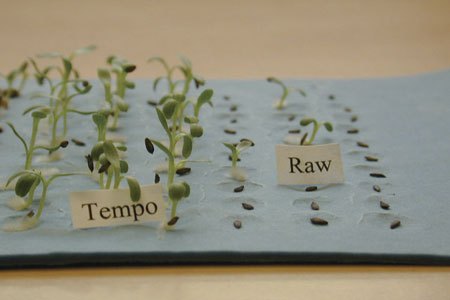
For farmers it is often important that seed germinate uniformly across the field. This synchronized germination is not a natural phenomenon but a trait bred into crops to facilitate uniform harvests. For example, if you are going to harvest soybean with a combine, all the legumes on all the plants need to be mature at the same time or else you will lose part of the crop to shattering and some will not have mature seeds. To help insure quick and uniform germination, seeds can be primed. In priming seeds are allowed to slowly uptake water. At a point prior to triggering of germination, the process is stopped, and the seeds are shipped to a grower. In Figure 9-7 you can see the effect of priming seed compared to raw seeds (no priming) on germination. Priming solution can also be used that provide a nutrient infusion for the young seedling.
Another change that can made to seeds prior to sowing is encapsulation. There can be many benefits to encapsulation. One is that very small seeds can be made larger. This can allow easier handling for mechanical sowing or hand-sowing. The seeds can be coated in various layers to help improve the seedlings chance of survival. Figure 9-8 demonstrates various coats that can be applied to a seed – fungicides, insecticides, fertilizers, growth promoters, beneficial bacteria and protective layers. These can increase self-life of the seed and improved germination and seedling success rate. Of course, this comes with a cost. Encapsulated seed are significantly more expensive that non-encapsulated seed. But, for some crops in problems fields, that expense may be offset by increased yields.

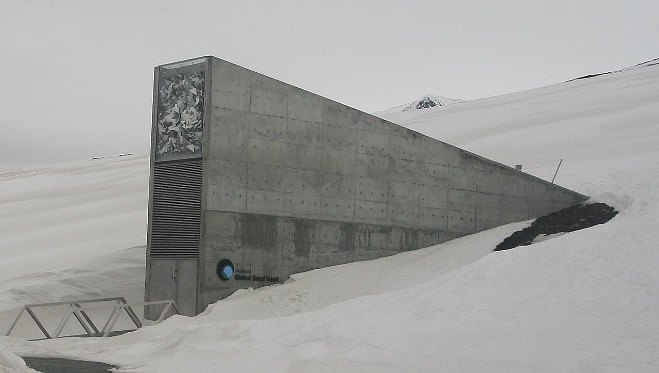
To maintain seed viability as long as possible, seeds should be stored in a cool, dry location. The temperature should not get below freezing with 4 to 8o C being ideal. Excess moisture needs to be avoided. It can stimulate germinate or encourage growth of pathogens, such as fungi and bacteria, on the seeds. Figure 9-9 is an image of the Svalbard Global Seed Vault located in Norway on a remote Arctic island. You can achieve the same thing, granted to a significantly smaller degree, by placing seeds in a tightly closed bag or container and placing them in a refrigerator drawer. You can do this to save left-over seeds from this year’s sowing or to save seeds from your garden until next spring. Even with ideal conditions, some viability will be lost. Conduct a germination test to determine how viable each seed type is prior to sowing.
This page titled 9.1.3: Seed Treatments and Storage was last modified on Sat, 14 Nov 2026 16:54:29 GMT and is shared under a CC BY-NC-SA 4.0 license and was authored, remixed, and/or curated by Stephanie Harvey.
The book could not be loaded just now.