Opening the book…
Crop Rotation
There are records back in the 16th century describing the benefit of crop rotation. This practice helps ameliorate some of the issues associated with monoculture. The practice involves swapping crops in a field through 3- or 4-season rotations. Obviously, the grower wants to plant crops that will increase his/her revenues but continue growth of a cash crop will lead to diminished returns as soil fertility drops and pest and disease occurrences increase. Several considerations must be considered when determining what the rotation will be. A preliminary assessment of crop interrelationships can be found in how each crop: (1) contributes to soil organic matter (SOM) content, (2) provides for pest management, (3) manages deficient or excess nutrients, (4) how it contributes to or controls for soil erosion, (5) interbreeds with other crops to produce hybrid offspring, and (6) impacts surrounding food webs and field ecosystems.
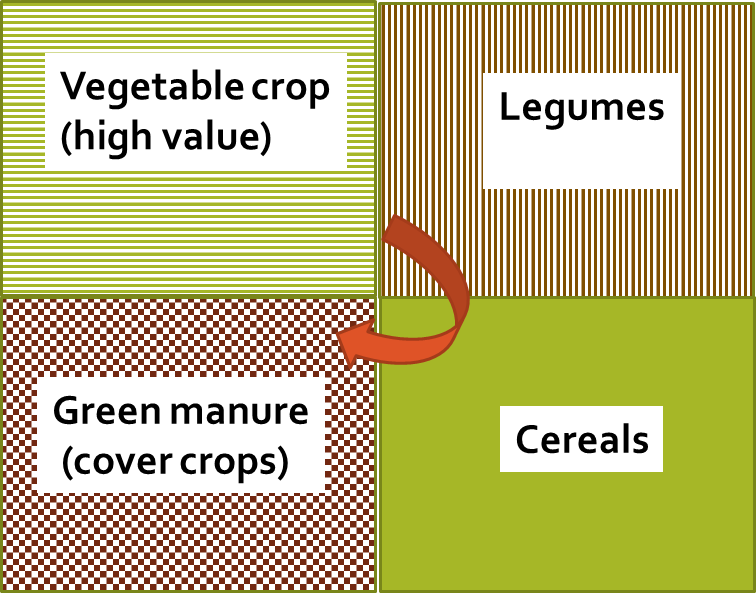
A typical rotation (Figure 10-4) involves high value crop, followed by a legume crop (replenishes nitrogen). This is then followed by a cereal crop and finally a cover crop (ideally green mature). Green manures are grown as covers where they prevent erosion when land is not cropped. Then prior to planting the next crop, the cover is plowed into the field to increase organic matter and general nutrient levels.
Intercropping
It is critical for a grower to maximize yield per unit area. With some crop, such as perennial tree crops, a significant amount of space is required to support the health of the trees. While the tree crop is young (and perhaps not producing yet) there is lost income and potential for soil erosion if there is no ground cover between the trees. Intercropping can help with this issue. It is the production of multiple crops in the same area at the same time. In Figure 10-5, Tagetes erecta (Aztec marigold) is a planted understory to the coconut trees. This maximizes utilization of growing area and can keep workers in jobs off-peak seasons.

This page titled 10.1.5: Cultural Techniques in Traditional Agriculture was last modified on Sat, 14 Nov 2026 17:34:06 GMT and is shared under a CC BY-NC-SA 4.0 license and was authored, remixed, and/or curated by .
The book could not be loaded just now.