Opening the book…
All solar energy striking a leaf has passed through multiple and/or complex media before reaching its destination. These media, like the atmosphere, impact light quality. Some wavelengths of light may be absorbed, while others get reflected (scattered). For example, a significant amount of UV radiation is filtered by the atmosphere (specifically the ozone layer). As VL passes from one medium to another with a different refractive index, these changes can often be seen (Figure 5-9). You have encountered this phenomenon. A straw in a glass of water appears bent or water in a pool looks shallower than it is.
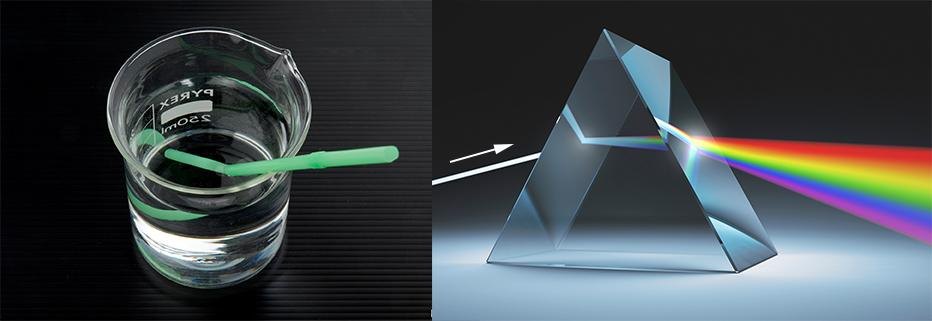
A prism is often used when demonstrating refraction because you can see a distinct change in the path of the light. You can also see a dispersal effect as the light exists the prism. In the second image in Figure 5-9, we can see the refraction and dispersal effects. As beam of light passes through air and then through a prism, the various wavelength interacts differently with the prism causing them to separate into the distinct color bands we associate with a rainbow.
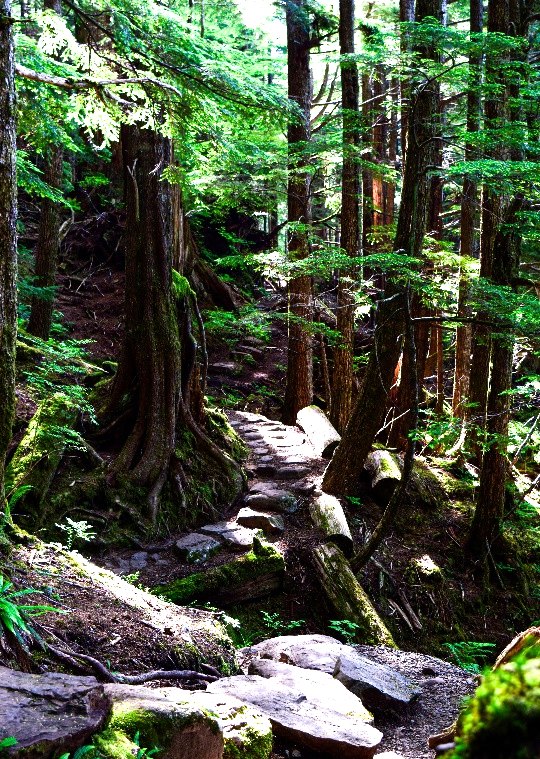
As light passes through the leaf canopy, the quality of light changes. There is a shift toward red with little light in the violet regions (Figure 5-10). This shift has a significant impact on the efficiency of chlorophyll a which absorbs heavily in that region. To compensate plants that live below the canopy have higher concentrations of chlorophyll b to take advantage of the available light since it absorbs more in the blue region than violet. Shaded plants also restrict their production of chloroplast and chlorophyll. With the limited light available, energy and resource expenditures to produce them would not be returned with increased photosynthetic productivity.
As the earth rotates, solar radiation passes through different thicknesses of the atmosphere. At sunrise and sunset, the distance that light travels is greater than when the sun is directly overhead. This creates more scattering of violet and blue wavelengths. Thus, the orange and reds tend to dominate creating colorful displays.
Shifts in the atmosphere's composition can affect the light waves that pass through it. Volcanic eruptions, fires, and other events can increase scattering of light and impact the wavelengths that are available for plant growth (Figure 5-11).

Archeological digs in England found mass graves initially thought to be due to the Black plague. However, dating processes determined that the deaths did not occur during the plague outbreak. What else could cause high mortality rates? Ice cores drilled in the arctic held a clue - ash. Researchers scoured ancient written records looking for a volcanic eruption that coincided with mass graves. They found one that occurred in South America and it was massive. The ash clouds blocked a significant amount of sunlight creating an induced winter. While the ash settled from the atmosphere, the chemical reactions that also took place in the atmosphere following this large-scale eruption extended the impact for nearly 2 years. The result was diminished sunlight and exceptionally cold weather leading to famine and high fatality rates.
This page titled 5.2.2: Refraction and Reflection was last modified on Fri, 13 Nov 2026 14:58:47 GMT and is shared under a CC BY-NC-SA 4.0 license and was authored, remixed, and/or curated by Stephanie Harvey.
The book could not be loaded just now.