Opening the book…
The flower is the primary reproductive structure of Angiosperms – flowering plants (Figure 3-34). On the most basic level a flower is a compressed stem of modified leaves. There are four whorls (or groupings) of modified leaves that produce 4 distinct floral parts. If viewing a flower from the proximal end of the floral axis to the distal end, the whorls are – sepals, petals, stamen, and carpels. The first two whorls are sterile (don’t produce gametes) while the last two are reproductive in nature.

The lower or outermost whorl consists of sepals (Figure 3-35). Collectively they are referred to as the calyx. The calyx protects the unopened bud. They may be non-showy, or they may contribute to the colorful display used to attract pollinators. On occasions when the appearance of the sepals is such that they are difficult to distinguish from the petal, both are referred to as tepals.

The next whorl is the petals, which are collectively called the corolla (Figure 3-35). In a typical flower, the petals are the showy, colorful bits that are to the interior of the sepals. The primary function of petals is to attract pollinators. Both the calyx and the corolla are non-reproductive components of the flower and are collectively called the perianth (Greek - “around” “flower”).
The third whorl of modified leaves consists of stamen. Stamen are the equivalent of the “male” component of the flower. Stamen are composed of an anther (where pollen is produced) supported by a filament. Pollen grains carry the sperm nuclei required for fertilization.
The female pistil (carpel) is formed from the innermost whorl of modified leaves. The terms carpel is more precise as it refers to an individual modified leaf. A pistil can be made up of a single carpel or multiple carpels fused together. Some flowers have multiple pistils.

A pistil has three components: stigma that receives the transferred pollen, the style which connect the stigma to the ovary and the ovary – the site of the ovules that house the egg.
As with all the plant organs we have discussed, flowers come in a variety of forms with significant modifications. Some flowers are missing one or more of the whorls and are said to be incomplete (as compared to a complete flower with all four components) (Figure 3-37). In image here show the flower of a grass. It is missing the entire perianth – no sepals or petals. The protective role of the sepals is carried out by modified leaves from below the flower (called bracts) and since the grass is wind pollinated, the lack of petals doesn’t create a problem. The flowers of grasses, such as wheat and ryes, are incomplete.

A more specific set of terms can be used to describe the sexuality of a flower. If the flower has both stamen and pistil, it is said to be perfect or bisexual. If one of the reproductive structures is missing it is said to be imperfect or unisexual. A pistillate flower is a flower with no stamen while a staminate flower has no pistil. A complete flower must be perfect, an imperfect flower must be incomplete, but an incomplete flower could be perfect or imperfect.

A species of plants with imperfect flowers may be monecious or dioecious (Figure 3-38). Monecious species have a plant form that houses both pistillate flowers and staminate flowers. In contrast, dioecious species have two plant forms – one that has only pistillate flower and one that has only staminate flowers. (mono – one “house;” dioecious two “houses”).
An inflorescence is the organization of flowers. The simplest is the solitary flower – single flower supported by a peduncle (Figure 3-39). Others are compound and consist of multiple florets (flowers) supported by pedicels while the entire inflorescence is supported by a peduncle. The image here shows an example of a raceme. Collections of small flowers can have an advantage over a single large flower. Loss of a single small bud, has less of an impact on the reproductive success of the plant but provides the same visual appeal to pollinators that a single large flower could.

There are many types of inflorescences (Figure 3-40). Some look like a collection of flowers on a single stem. Others take on the attributes of a single flower. The common sunflower or Zinnia appears to be a flower but in reality, is an inflorescence referred to as a head or capitulum. The petal-like structures are individual flowers called rays and the central part that resembles a cluster of stamen and pistils are really hundreds of disk flowers.
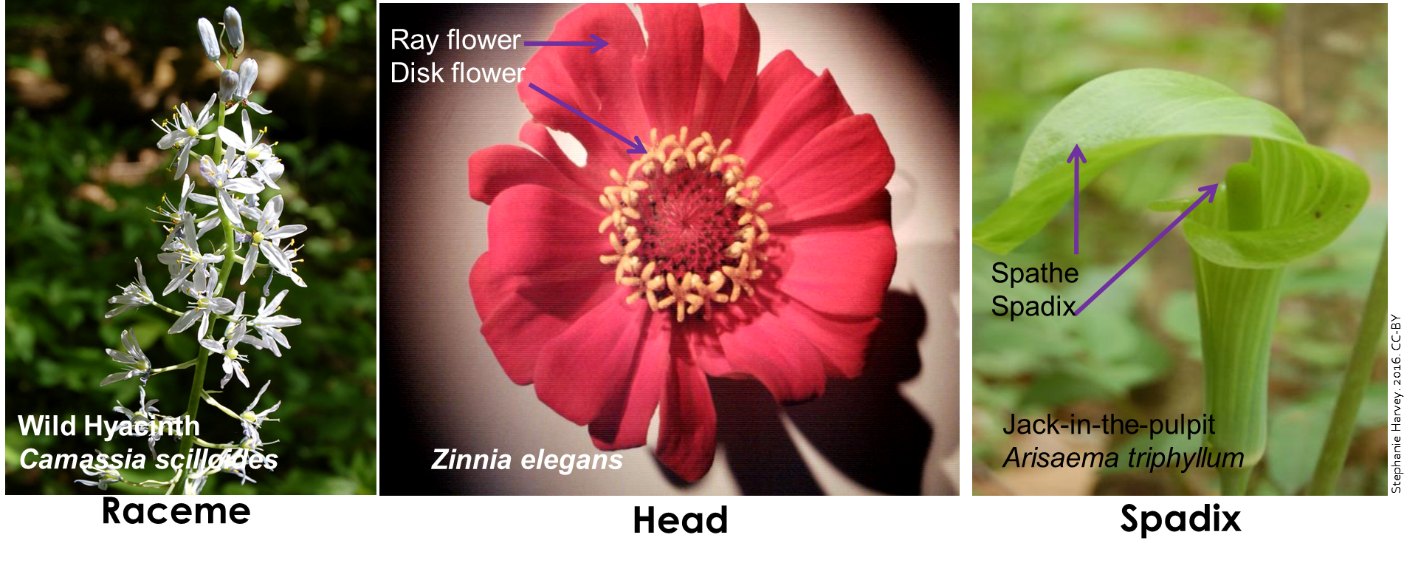
Some inflorescences don’t look like flowers at all. A spadix is an inflorescence consisting of a fleshy axis covered with minute flowers that lack perianths. A special bract called a spathe is associated with the spadix. In the case of Jack-in-the-pulpit, the spathe effectively wraps around and “hood” the spathe. The vast array of floral organs is mind blowing and we could spend an entire class just discussing them, but we will move on. However, next time you see a “flower” stop and take a good look at what is there and what is not.
This page titled 3.5.1: Flowers was last modified on Thu, 12 Nov 2026 20:10:17 GMT and is shared under a CC BY-NC-SA 4.0 license and was authored, remixed, and/or curated by Stephanie Harvey.
The book could not be loaded just now.