Opening the book…
Traditionally the angiosperms, Phylum Magnoliophyta, were divided into two clades: monocots and dicots. However, our current understanding of angiosperm phylogeny divides Magnoliophyta into four (4) groups: monocots, eudicots, basal angiosperms and magnoliids.

This cladogram, shows the three basal angiosperms diverging from the ancestral line first, followed by the monocots, then the magnoliids and finally the Eudicots.
Basal Angiosperms
Basal angiosperms are a group of plants that are considered to be among the most primitive or "basal" lineages of flowering plants (angiosperms). They represent a diverse array of plants that share certain characteristics and are believed to have diverged early in the evolution of flowering plants. Basal angiosperms are considered to be living fossils, providing valuable insights into the early stages of angiosperm evolution.
There are only a few hundred species in this grade. The group of basal angiosperms includes three main lineages: Amborellales (1 species), Nymphaeales 70-90 species, and Austrobaileyales (one hundred species). Amongst these lineages, the exact relationships are not clear. Let us explore each of these lineages and their defining features:
1. Amborellales: The Amborellales (Figure 2-35) are represented by a single living species, Amborella trichopoda. This plant is native to New Caledonia, a group of islands in the Pacific. Amborella is a small shrub with simple, opposite leaves. It produces small, inconspicuous flowers with spirally arranged floral parts. One notable characteristic of Amborella is its primitive reproductive features, such as a large number of spirally arranged stamens (male reproductive structures) and a lack of a well-defined carpel (female reproductive structure).
2. Nymphaeales: The Nymphaeales include aquatic or semi-aquatic plants commonly known as water lilies (Figure 2-36). This group encompasses families such as Nymphaeaceae (water lilies) and Cabombaceae (water shield). Nymphaeales are characterized by floating or emergent leaves and showy, fragrant flowers. The flowers have numerous petals and numerous stamens, arranged in spirals or whorls. Water lilies often have large, round leaves that float on the water's surface.

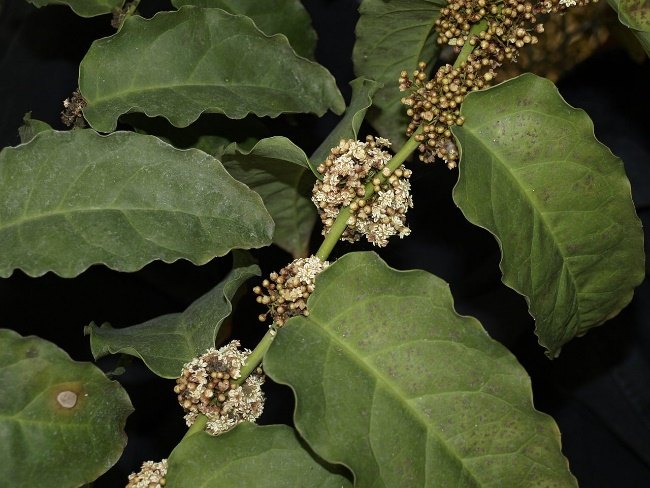
3. Austrobaileyales: The Austrobaileyales (Figure 2-37) lineage consists of a few families, including Austrobaileyaceae, Schisandraceae, and Trimeniaceae. Members of this group are predominantly found in tropical and subtropical regions, mainly in Southeast Asia. Austrobaileyales plants can be shrubs, small trees, or lianas. They often have simple, alternate leaves. Flowers of Austrobaileyales plants are usually small and not very showy, with an arrangement of floral parts that can vary among different families. Star Anise, Illicium floridanum, is a shrub native to Southern United States, from Florida to Louisiana.

Basal angiosperms display several characteristics that differentiate them from more derived angiosperms. For example, they often possess numerous, spirally arranged floral parts, lack specialized floral organs, have simple leaves, and exhibit primitive features in their reproductive structures.
These traits provide insights into the early evolutionary stages of flowering plants and help scientists understand the diversity and adaptations of ancient angiosperm lineages. Their existence provides valuable clues about the characteristics and environmental conditions of the early angiosperm world. By examining the anatomy, genetics, and reproductive strategies of basal angiosperms, researchers can gain a deeper understanding of the origins and subsequent diversification of flowering plants.
Magnoliids
The magnoliids is an informal name that corresponds to a clade composed of Canellales, Laurales, Magnoliales and Piperales. This clade appears to have diverged from the lineage leading to eudicots after the divergence of the monocots. The magnoliids include a wide range of plant families, but some of the most well-known and recognizable members belong to the magnolia, laurel, and nutmeg families. Examples of magnoliids include magnolias (Magnoliaceae), tulip trees (Liriodendron), bay laurels (Lauraceae), sassafras (Sassafras), and nutmeg (Myristica fragrans).

The Magnoliids share several characteristics. One of the defining features of magnoliids is their primitive floral structure (Figure 2-38). Their flowers typically have numerous petal-like tepals that are not clearly differentiated into distinct petals and sepals. The floral parts are often arranged in multiples of three (trimerous) or a multiple of three. Magnoliids possess primitive vascular tissues known as tracheids, which are elongated, water-conducting cells found also in the gymnosperms. Tracheids lack the specialized end walls found in more advanced angiosperms, called vessel elements. This distinction is one of the features that separates magnoliids from other flowering plants.
The leaves of magnoliids are generally simple, meaning they are not divided into leaflets. Their phyllotaxy is often alternate, meaning they are arranged singly along the stem, rather than opposite or whorled. Magnoliids have cultural significance, as some species, such as magnolias and bay laurels, are highly valued for their ornamental and aromatic qualities. They produce a variety of secondary metabolites, such as alkaloids, lignans, and essential oils. These compounds often contribute to the aromatic properties and medicinal uses of magnoliid plants. Additionally, certain magnoliids have historical uses as medicinal plants, flavorings, or sources of timber and essential oils. Some examples from this group include avocado, cinnamon species, black pepper, nutmeg, and bay laurel. The southern magnolia, Magnolia grandiflora, is often planted in landscapes.
Monocots
Monocots, short for monocotyledonous plants, make up more than 25% of the angiosperms. As their name implies, they develop a single cotyledon or seed leaf in their seeds. They also have other key characteristics that separate them from the other angiosperms.
The leaves of monocot are typically long, narrow, and have parallel venation, meaning the veins run parallel to each other from the base to the tip of the leaf (Figure 2-39). Most of the veins will be of equal size although some plants have a distinctly larger mid-rib. Examples of monocots with well-known leaves are grass, rice, wheat, and maize.
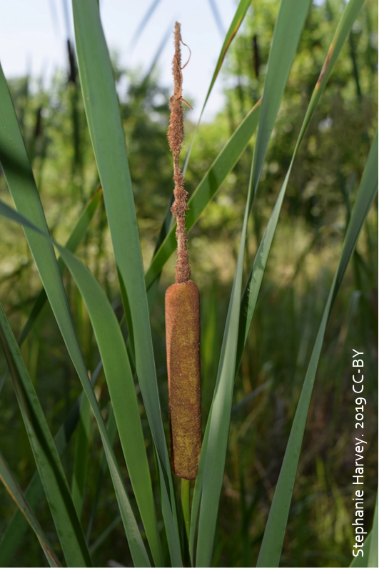
The floral structure of monocots often exhibits certain patterns. Monocot flowers typically have floral parts in threes or multiples of three. This is specifically true for petals, sepals, and stamens. If the ovary is compound it will form from three carpels (Figure 2-40). Not all monocots produce showy flowers. Grasses, for example, have lost their petal and sepal. Most people do not even recognize them as flowering plants. Another reproductive characteristic is that the pollen grain of the monocots typically has a single pore or furrow through which the pollen tube will immerge. Examples of showy monocots include orchids, lilies, and amaryllis.

In contrast to the taproot systems typical of the eudicots, monocots generally have a fibrous root system, with numerous thin roots that arise from the base of the stem. This occurs because the radical (the embryonic root) typically dies not long after seed germination. It is replaced by adventitious roots produced from the lower stem. These roots tend to stay the same size, and a taproot is not established.
If you are able to get a look at the stem or root of a monocot under the microscope you will see a pattern in the arrangement of the vascular bundles. In the monocot root, the vascular bundles are arranged in a ring. This creates two distinct areas – a cortex region and a pith region within the ring. In the stem, the arrangement of vascular bundles is usually scattered. However, this arrangement is not random. These are arcs of bundles produced by the sheathing bases of the leaves.
Monocots encompass a vast range of plants across different habitats and life forms. Some examples of monocots include grasses (Poaceae family), lilies (Liliaceae family), orchids (Orchidaceae family), palms (Arecaceae family), irises (Iridaceae family), and bananas (Musaceae family). They have ecological and economic significance. Grasses, such as wheat, rice, and corn, are major food crops that provide a significant portion of the world's caloric intake. Many ornamental plants, including lilies and orchids, belong to the monocot group. Additionally, several monocots are utilized for their fibers, such as sisal from Agave species.
Eudicots
The eudicots make up more than two-thirds of the angiosperms and as their name implies, they develop two cotyledons or seed leaves. There are many economically important members in this group including the rose family (Rosaceae), legume family (Fabaceae), squash family (Cucurbitaceae), oak family (Fagaceae) and many others (Figure 2-41). Their growth habits range from herbaceous plants to large trees.

It is often useful to be able to distinguish between monocots and eudicots. It is often one of the first steps in identifying a plant species. It can also be helpful in more practical applications. For example, selective herbicides are available that will kill on group but not the other. So, if you have a weedy grass in your garden amongst your peas and beans, an herbicide that targets only monocots would work well without the potential to harm your crops.
One of the characteristics that is often used to determine if a plant is a monocot or eudicot is leaf venation (Figure 2-42). As mentioned in the previous section, monocots typically have leaf veins that run parallel to each other and the edge (margin) of the leaf. On the other hand, Eudicots have net-like venation. That is the veins branch and spread across the leaf surface.

The number of floral parts (sepals, petals, stamen, carpels) with the flowers of the two groups also differs. Monocots have floral parts in sets of three. Eudicots have floral parts in sets of 4s or 5s. Within a flower, always count two different floral parts and determine if they agree with one another.
The type of root system may also be helpful in classification. While monocots typically have fibrous roots systems, while eudicots have a taproot (main root) present. This difference develops soon following germination of a seed. In eudicots, the embryonic root continues to grow, increasing in size and producing lateral roots. In contrast, the embryonic root of the monocot is replaced with multiple roots from stem tissue.
The onions (Figure 2-43) in the first image have many roots of about equal diameter and length. The white onion bulb visible is not a root – it is a collection of storage leaves attached to a compress stem disk. It is from this stem disk that the root emerges.

There are other distinguishing characteristics as well, but not all are suited for use outside of a laboratory or classroom setting. This table lists the characteristic that differ between monocots and eudicots. The first three and the last we have already discussed.
| Characteristic | Monocot | Eudicot |
|---|---|---|
| Leaf venation | Usually parallel | Usually netlike |
| Floral parts in multiples of | Three | Four or five |
| Roots | Fibrous | Taproot |
| Pollen grain openings | One pore | Three pores |
| Vascular bundles in stem | Scattered bundles | Bundles in a ring |
| Vascular bundles in root | Bundles in a ring | Bundles form a solid center |
| Embryo cotyledons | One cotyledon | Two cotyledons |
The pollen grains of monocots have only a single pore in the pollen’s exine while eudicots have three pores. The arrangement of the vascular bundles can be helpful if you can look at a cross section of the stem or root under a microscope. In the stem, vascular bundles of monocots appear scattered amongst the ground tissue. In eudicots, the vascular bundles are arranged in a ring dividing the ground tissue into two regions: cortex and pith. In contrast to the stem, it is the roots of monocots that have vascular bundles in a ring, while the eudicot root has the vascular bundles forming a solid central core.
Because members within either group have the potential to gain or lose specific traits through genetic changes, it is wise to ensure that 2-3 characteristics are met when trying to identify a specific plant into the monocot or eudicot group.
One of the most interesting aspects of angiosperm diversity is the changes brought about through co-evolution with animals, in particular insects. Initially, all pollination was carried out via the wind. This required an extensive investment by the plant toward the production of pollen. Copious amounts were needed to ensure that some would reach the correction species and the correct time so that fertilization could occur. Plants that could attract insects to move the pollen from site A to site B, had a distinct evolutionary advantage due to increased reproductive success. And if a very specific pollinator could be attracted, then even higher rates of reproductive success were possible while producing less pollen and thus saving resources.

The Rafflesia (Figure 2-44) has evolved a mechanism to attract a specific group of pollinators – flies. Its flower produces the scent of rotting meat. While not an attractive smell to us, to flies that are looking for rotting meat to lay their egg in, it must seem heavenly. They arrive at the flower and walk around its surface looking for meat all the while picking up pollen. When they do not find a suitable spot to lay their eggs, they fly off to find some rotting meat only to be misled again by another Rafflesia. Now while looking for that elusive rotting meat they transfer pollen to the new flower and pick up more pollen before moving on.
The bee orchid has a similar approach. It uses its appearance and the production of female bee hormones to lure male bees in. While they fruitlessly attempt to mate with the orchid flower, pollen is deposited on their head. They fly off, frustrated I am sure, only to lured back to mate with another false female and pollination is achieved.
While the previous examples make it seem like the insects are getting the short end of the stick, so to speak, co-evolution works both ways. Many plants produced secondary metabolic compounds that help prevent organisms from eating them. The milkweed family, for example, produces group of cardiac glycosides in their latex that should protect the plant from most grazers. However, the caterpillars of the monarch butterfly and milkweed bugs feed on milkweed plants without suffering any ill effects (Figure 2-45). To add insult to injury, they sequester the glycosides rendering the insects noxious to predators.

This page titled 2.4.2: Angiosperms - Flowering Plants was last modified on Thu, 12 Nov 2026 18:53:53 GMT and is shared under a CC BY-NC-SA 4.0 license and was authored, remixed, and/or curated by Stephanie Harvey.
The book could not be loaded just now.