Opening the book…
Now days there are many sources for purchasing seeds – garden center, agricultural suppliers, mail-order, discount stores and online. However, there are several things one needs to consider before purchasing seed. Not all seeds are equal and sometimes what seems like a bargain is not. Failure to handle the seed properly can lead to non-viable seeds - ones that don’t germinate. When you are looking to buy seeds, you want to look for reputable sources. Companies that sell seeds to growers are probably the most reliable due to the economics riding on the success of the crop. This may be local source (in Americus, Farmers’ Seed & Feed Services) or through online or mail order catalogs. Other sources, such as nurseries and garden centers, friends that save seeds, collections from the wild or your own garden can be just as good but may have more relaxed quality control.
Seed quality is a critical concern when purchasing seeds. Many factors impact seed quality. Exposure to high temperatures, such as being stored in a non-climate-controlled warehouse, can negatively impact viability. Sanitation during and after seed harvest can also impact seed quality. Exposure of the seed to pathogens, such as fungi and bacteria can lower seed viability or lower the survival rate of seedlings post-germination. Seed contamination with weed seed is another concern. The hitch-hiking seeds lead to new weed problems in gardens and fields. A number of our invasive plant species arrived in the US via seed source contamination.
The age of a seed will have an impact of the seed’s quality. Seeds become less viable as they age. While some seeds can be viable for 50 plus years (some of the grains and pseudocereals) other have very short shelf-lives. In general, larger seeds and seed with high oil content tend to have shorter viability windows. So, be aware of older seeds. If you are buying prepackaged seeds the year should stamped on to the package. Saving extra seeds not planted one season for use in the next is may not be the best option.
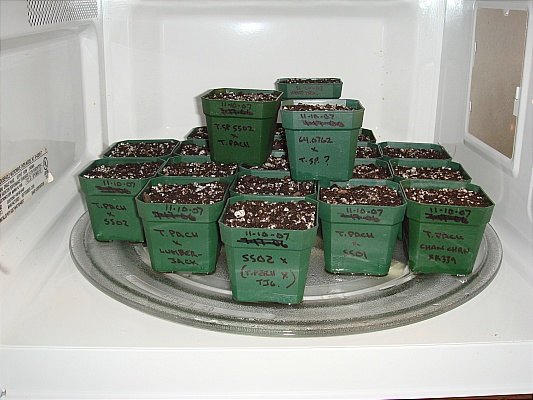
The storage and handling of seeds is important. While not very active – the seed is said to be dormant- the embryo is alive. A seed is more resilient than a plant in most cases but can be impacted by environmental conditions. Exposure to heat, cold, desiccation and chemicals can kill the embryo. If the embryo is dead the seed will not germinate. Heat is commonly used to kill weed seeds in soil. While steam is used on large scales production, a microwave can be used for small home batches of soil (Figure 9-3). Extreme cold can also be used to kill. Storage of soils at minus 80o Celsius is a sterilization technique used when moving soil across borders because it kills most biota (living things), including seeds.
If you have older seeds or perhaps could not pass up on the 10 packs for $1.00 at the discount store, you should conduct a germination test prior to sowing (planting) the seed to check their viability. Start by randomly selecting 10 seeds from the seed package. Soak the seeds for 8-10 hrs and then place them in a dish on damp paper towels (Figure 9-4). Monitor the seeds for the next few days to weeks keeping the paper towels damp. Note when the first seed germinates and continue to follow until no more are germinating. If only 8 out of 10 germinated, then your germination rate or viability rate is 80%. Knowing the germination rate, you can sow enough seeds to compensate. For example, if you want 12 pepper plants and your germination rate is 80%, you need to sow 15 seeds to compensate for the reduced viability. If your germination rate was 50%, you would want to sow at least 24 seeds.

Some seeds may need more attention to ensure germinate and one away to see if your seeds need “special’’ attention is to look at the seed package. The seed package contains a lot of valuable information (Figure 9-5). It should have a “Sell by” or packed for date stamped on the package. If you purchase seed and there is no information about when it was packed, you should be concerned. The package should also contain the point of origin and the lot number. Both of these pieces of information can be helpful if you need to track the seed back to its original source. The seed packets also include a lot of practical information for the sowing of the seeds. Some of the things typically given on seed package include instructions for propagation – depth to plant seeds, spacing between seeds/plants, days to the emergence of seedlings and days to harvest/bloom. They can provide a calendar as to when to plant based average soil temperatures for a region. This is typically shown in map format. So, for southwest Georgia, these seeds could go in the ground Jan-April and Aug-Nov. A new addition to the package information is a QR code (blurred in Figure 9-5 for copyright purposes). By scanning a QR code, it can lead you to a website with more information about these plants/seeds.

This page titled 9.1.1: Seed Sources was last modified on Sat, 14 Nov 2026 16:43:41 GMT and is shared under a CC BY-NC-SA 4.0 license and was authored, remixed, and/or curated by Stephanie Harvey.
The book could not be loaded just now.