Opening the book…
To avoid this over estimation, hydroponics was used to isolate each essential nutrient and to verify the concentrations needed for plant growth. Hydroponics is a system in which nutrients are dissolved in water. Plants are then grown in the resulting solution. The plants can then be closely observed for signs of deficiencies in their tissues can be analyzed for mineral content.
In Figure 8-3, sunflower plants are growing in solutions that contain uranium and radium. Neither of these are essential elements but it nicely demonstrates how a hydroponic system could be used for determination of nutrient need. Here, however, the plants are being investigated for their ability to remove these elements from the soil as a form of bioremediation.
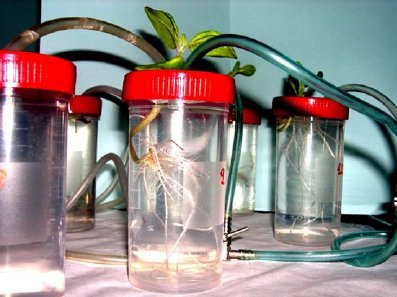
Based on hydroponics studies, a list of essential nutrients has been developed (Table 8-2). As refining techniques improved to limit contaminants in the chemicals used, the list was modified to include even trace level requirements. The essential nutrients were divided into 2 categories based on the level of the nutrients needed by the plants: Macronutrients are needed in higher concentrations and are typically reported as percent of the plant biomass. Micronutrients are needed at lower concentrations and are typically reported as parts per million and parts per billion.
The elements of carbon, hydrogen and oxygen make up the bulk of the dry mass of plant tissues. They are macronutrients. However, since these elements are readily available and rarely contribute to deficiencies, they are often ignored when looking at plant nutrients.
| Macronutrients | Micronutrients |
|---|---|
| Carbon (air) | Iron |
| Hydrogen (air/water) | Molybdenum |
| Oxygen (air/water) | Boron |
| Nitrogen (primary) | Copper |
| Phosphorus (primary) | Manganese |
| Potassium (primary) | Sodium |
| Sulfur | Zinc |
| Calcium | Nickel |
| Magnesium |
There are 3 primary macronutrients: nitrogen, phosphorus, and potassium. There are also 3 secondary macronutrients: sulfur, calcium, and magnesium. Most of the macronutrients are components in biological molecules such as proteins and nucleic acids. Micronutrients typically work as cofactors with enzymes. They include iron, molybdenum, boron, copper, manganese, sodium, zinc, and nickel. Some of the micronutrients are needed at such small levels they are often referred to as trace elements.
There are some nutrients that are essential to a select group of plants but are not included in our list since they are not critical to all plants. Examples of elements that are essential to a small subset of plants include aluminum, cobalt, silicon, and selenium. For example, silicon is essential in horsetails. In these plants, silicon strengthens the cell wall and without it the plant cannot support its own weight. It collapses and does not complete its life cycle.
This page titled 8.2: Hydroponics and the Essential Nutrients was last modified on Thu, 05 Nov 2026 20:13:15 GMT and is shared under a CC BY-NC-SA 4.0 license and was authored, remixed, and/or curated by .
The book could not be loaded just now.