Opening the book…
Carbon Dioxide
As photoautotrophs, plant can produce their own organic molecules from inorganic sources such as carbon dioxide (CO2). Carbon dioxide (a gas) is plentiful in the atmosphere. It can reach the chloroplast in the mesophyll cells of a leaf by diffusing through the stomatal pores and into the interior of the leaf. The cuticle prevents desiccation of the leaf tissue but also prevents carbon dioxide from diffusing directly through the epidermis. The Figure 4-5 shows a cross-section through a monocot leaf. The chloroplasts are stained red, and we can be seen in the mesophyll and in the bundle sheath cells that surround the veins (aka. vascular tissue). Not the deep pink layer to the outside of the leaf this is the cuticle.

Water
Water is required for photosynthesis as well as most metabolic processes (Figure 4-6). Water is obtained through the roots of a plant and is transported in the xylem. The tissues of a plant are flushed with water, and it is not a reactant that limits the photosynthetic process - at least not directly.
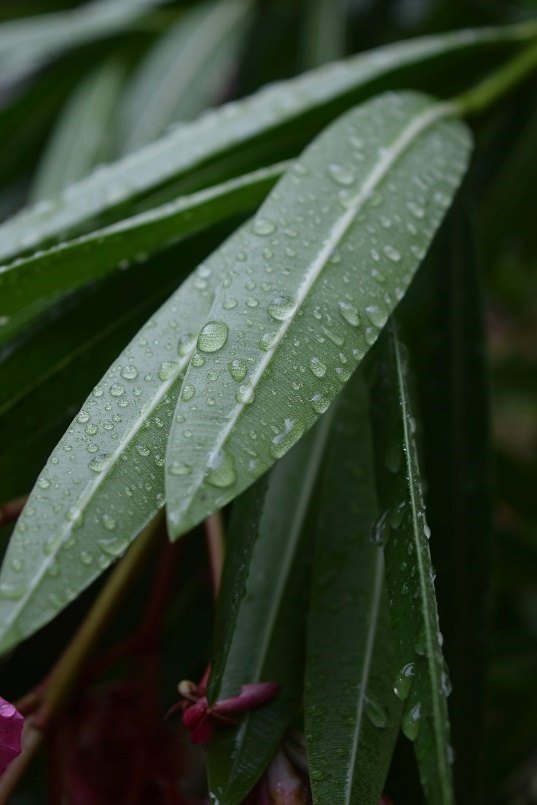
As a plant's stomatal pores open to allow for diffusion of carbon dioxide, critical water is lost through the same pores. As much as 99% of the water taken in by plants is lost due to the need for gas exchange. Plants are in a constant struggle between water conservation and gas exchange. Ultimately, the need to conserve water wins out over the need for gas exchange and the guard cells close the stoma. But there is a cost. Without carbon dioxide, the plant cannot continue to transform light energy into carbohydrates.
Light
Light energy is only a small part of the electromagnetic spectrum with wavelengths from approximately 400 nm to 700 nm. Leaves are the primary site of light absorption. They are typically thin, flat structures that allow for maximum surface area with minimal resource expenditure. Leaves commonly absorb about 80% of the visible light that reaches them. Photosynthetic efficiency is affected by light intensity, quality, and duration. These characteristics vary with the time of day, season, altitude, latitude, and atmospheric composition. This will be discussed more in a later chapter.
This page titled 4.1.2: Required Reactants was last modified on Thu, 12 Nov 2026 20:29:44 GMT and is shared under a CC BY-NC-SA 4.0 license and was authored, remixed, and/or curated by .
The book could not be loaded just now.