Opening the book…
The method of applying fertilizers will vary depending on the nature of the planting, the plant’s individual nutritional needs, and their growth stage. For example, transplanted tomatoes, eggplants, and peppers can get a jump start with the use of the starter solution that is applied during the transplant process. Techniques and equipment can also change depending on the size of fields and plants.
One application method is referred to as broadcasting. Broadcasting a fertilizer refers to the spreading of fertilizers uniformly over an area. This method is often used on fields prior to planting in which case it is referred to as a basal application. It can also be used to apply fertilizers to establish lawns this is referred to as top dressing.
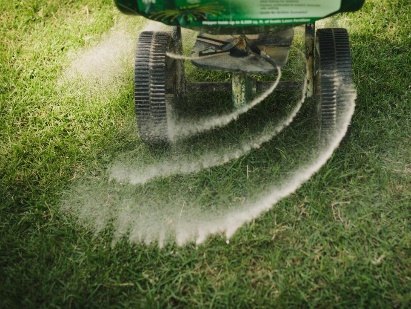
Broadcasting can be carried out using large-scale equipment, small homeowner size pieces of equipment like the ones in Figure 8-19 or simply by hand scattering. There are some disadvantages to broadcasting. The nutrients cannot be freely utilized by plant roots unless it is placed near the root tips. If roots fail to contact the nutrients only weakly stimulated growth may occur across the field. Nutrients can wash away from the soil easily and there is the risk of burning if over applied.
Although traditionally broadcasting was restricted to dry synthetic fertilizers, equipment has been developed to allow broadcasting of both solid and liquid manures on fields. In Figure 8-20 shows both a solid manure and a liquid manure spreader.

Banding fertilization involves the addition of fertilizers to the side of growing plants. It is sometimes known as “side dressing” (Figure 8-21, A-B) In contrast to the broadcast method, banding places the fertilizer within the reach of the plant but not across the whole field. This helps conserve fertilizers and decreases the amount of leaching and runoff. Higher concentrations can be applied without risks. However, it requires specialized equipment for large scale applications and more time consuming since multiple passes are required.
Mobile nutrients such as magnesium can be applied using foliar feeding and can provide a quick growth response when needed (Figure 8-21, C). Some micronutrients such as zinc or iron often get locked into the soil because of their reactivity. In other cases, the plants may not be able to extract nutrients due to cold temperatures of the soil. In both of these cases foliar application can produce the desired results. Absorption begins within minutes after application and with most nutrients is complete within 1 to 2 days. Foliar fertilization can be a supplemental to soil fertilization at critical times in the plants grow it is not however a substitute for soil fertilization. Foliar applications can be expensive and there is an increased possibility of chemical burning to the plants.

Fertigation is the application of fertilizers within the watering system. For this to work the fertilizers must be highly soluble in water. Otherwise, undissolved components can block outlets or sprinkler heads. The combination of watering and fertilizing is ideal. Without water applied fertilizers cannot reach the roots nor can they be absorbed. There is a significant reduction in labor for this application, but the soluble fertilizers are more expense. The delivered fertilizers must be diluted to prevent burning of leaves and other tissues. Fertigation can be applied with synthetic fertilizers or with organic fertilizers. It is common to pump liquid out of manure lagoons onto crops.
This page titled 8.6: Application Methods for Fertilizers was last modified on Sat, 14 Nov 2026 16:32:22 GMT and is shared under a CC BY-NC-SA 4.0 license and was authored, remixed, and/or curated by Stephanie Harvey.
The book could not be loaded just now.