Opening the book…
 Keep vessels closed except when access is needed. When opening a vessel, protect the inner cap surface and the op
 ening from unapproved contact. Avoid passing hands, sleeves, and used items over exposed openings.
Use deliberate movements that preserve the workspace and the cabinet's airflow. A rapid reach may disturb airflow or move a used object into the clean supply area.
Maintain control of pipette tips and fluid paths. Do not let a protected tip touch the work surface, glove, vessel exterior, or another sample. When a tip becomes unsuitable, replace it using the approved procedure.
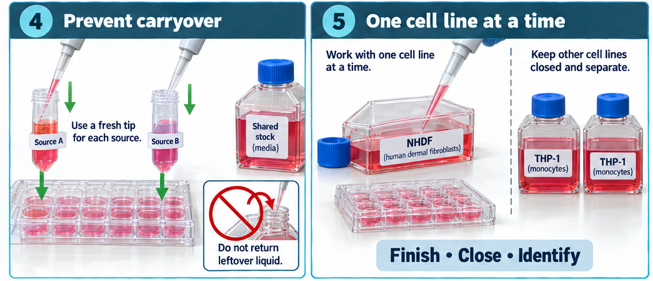
Use separate suitable tips or pipettes between sources where carryover could occur. Do not return unused liquid from a transfer vessel to a shared stock unless the approved process specifically permits it.
Limit open handling of different cell lines at the same time. Finish, close, and identify one operation before another creates a chance for mix-up or transfer. Keep source and receiving vessels clearly distinguishable.
Small choices have large consequences. A cap placed inner-side down on a surface creates a different risk from a cap held without touching its protected interior. A fresh tip does not correct a receiving vessel whose interior has already been touched. Good technique is continuous. It depends on protecting the next contact, not simply completing an initial cleaning step.
Attribution: Images AI-generated using ChatGPT Modified by Emalee Mackenzie, Irvine Valley College. Licensed under CC BY-NC-SA
This page titled 5.7: Protecting Sterile Surfaces During Handling was last modified on Wed, 21 Oct 2026 01:36:00 GMT and is shared under a CC BY-NC-SA 4.0 license and was authored, remixed, and/or curated by Emalee MacKenzie.
The book could not be loaded just now.