Opening the book…
A culture may appear healthy under the microscope, with clear medium and 
cells of the expected shape, yet test positive for mycoplasma. These small bacteria lack a cell wall and can contaminate cultures without causing visible cloudiness. They may alter cell growth, metabolism, and experimental responses. Visual observation shows the culture’s appearance, while a mycoplasma test checks for a specific contaminant.
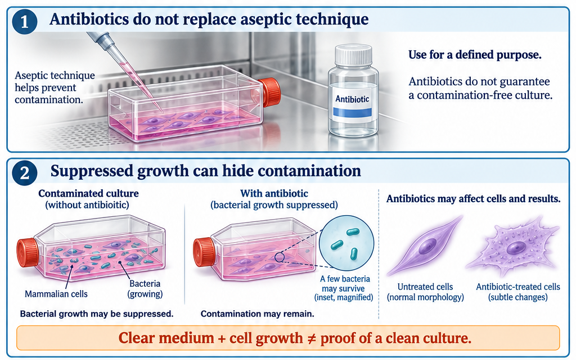
Visual checks can reveal some problems, but they cannot detect every contaminant. Unwanted microorganisms may be present before they cause noticeable changes in the medium, cell shape, or growth. For example, a sterile pipette tip that touches a work surface before entering a culture vessel creates a possible route of contamination. The culture may look unchanged afterward, but its appearance does not establish that the transfer was safe.

Aseptic technique consists of practices that reduce the chance of introducing unwanted microorganisms during handling. These practices include protecting sterile surfaces, using suitable supplies, and maintaining an appropriate workspace.
Contamination control must continue throughout the procedure. Careful preparation provides a strong starting point, but each transfer, vessel opening, and movement must preserve that protection.
Attribution: Images AI-generated using ChatGPT Modified by Emalee Mackenzie, Irvine Valley College. Licensed under CC BY-NC-SA
This page titled 5.1: A Clear Culture Can Still Be Contaminated was last modified on Wed, 21 Oct 2026 01:35:59 GMT and is shared under a CC BY-NC-SA 4.0 license and was authored, remixed, and/or curated by Emalee MacKenzie.
The book could not be loaded just now.