Opening the book…
Taenia saginata
Resides: intestines
Transmission: ingestion of raw/undercooked beef containing cysticerci
Disease: mild infections - may be asymptomatic; heavier infections - may cause diarrhea, abdominal cramping and pain, as well as vague digestive complaints; sever infections - produce body weakness, loss of weight, loss of appetite, vomiting, dizziness, and anemia; acute infections may cause colon blockage, may cause the colon to rupture or burst
Other Information:
- Common name: beef tapeworm
- One of the largest tapeworms, composed of up to 2000 proglottids, may exceed 25 ft in length
- Anchors to the lumen of the small intestine via a scolex with suckers
Source: CDC DPDx, Wikimedia Commons, Public Domain


Source: CDC, CDC PHIL, Public Domain
Taenia solium
Resides: Location dependent on form acquired
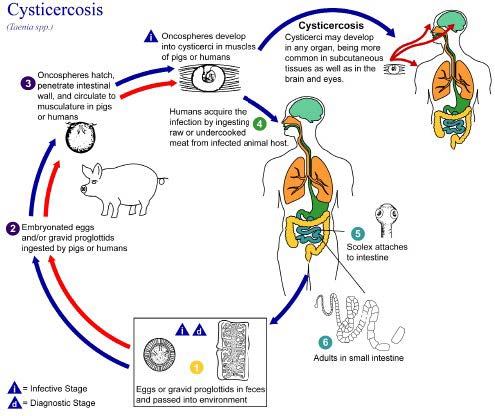
- Cysticeri ingested from raw or undercooked pork - develop into mature tapeworms that reside within the intestines
- Eggs ingested - eggs hatch and larvae penetrate the intestines and migrate throughout the body to encyst as cysticerci within the host tissues
Transmission: two different forms of the parasite can be acquired
- Cysticeri ingested from raw or undercooked pork
- Eggs ingested on contaminated food or drink - due to breakdown in hygiene Disease: Different ingest forms result in different disease conditions
- Cysticeri ingested from raw or undercooked pork - develop into mature tapeworms that reside within the intestines (taeniasis) characterized by the following:
- Mild infections may be asymptomatic
- Heavier infections may cause diarrhea, abdominal cramping and pain, as well as vague digestive complaints
- Severe infections - produce body weakness, loss of weight, loss of appetite, vomiting, dizziness, anemia
- Eggs ingested - cysticerci may develop resulting in cysticercosis which is characterized by the following:
- cysticerci may develop in various organs (i.e. brain, heart muscle, eye, etc.) causing damage to the organ
- cysticerci in the brain is known as neurocysticercosis; patients may exhibit seizures, psychiatric disturbances or other neurological impairments
Other Information:
- Common name: pork tapeworm
- Patients with taeniasis may pass proglottids in their feces
- May produce 50,000 eggs per proglottid
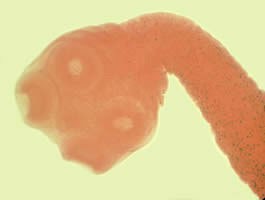
- Scolex has an armed rostellum (suckers with hooklets) used to attach to the host’s intestines
- Most dangerous of the tapeworms due to the risk of developing cysticercosis
Source: Alexander J. da Silva, PhD; Melanie Moser, CDC PHIL, Public Domain

Credit: Sherry Smith

Source: Evans C, Garcia HH, Gilman RH and Friedland JS, Wikimedia Commons, Public Domain

Hymenolepis nana
Resides: intestines
Transmission: accidental ingestion of eggs (human to human contact; fecal-oral route - fecal contamination of food or water; self inoculation - commonly especially in children; breakdown in personal hygiene)
Disease: Hymenolepiasis - asymptomatic; Heavy infections may case nausea, diarrhea, and abdominal pain, anal itching
Other Information:
- Common name: dwarf tapeworm
- Knob-like scolex
- Normally about 150 - 200 proglottids in length
- Does not require an intermediate host
- One of the common human cestode parasites worldwide
- Life cycle unique from other tapeworms due to requirement of only one host

Source: Alexander J. da Silva, PhD; Melanie Moser, CDC PHIL,
Public Domain

Source: Georgia Division of Public Health, Wikimedia Commons, Public Domain

Scolex_B)_gravid_proglottid..jpeg?revision=1)
Dipylidium caninum
Resides: intestines
Transmission: ingestion of the flea that carries the larvae
Disease: asymptomatic or may have mild gastrointestinal disturbances; most striking in small children is passing of proglottids in feces
Other Information:
- Commonly found in dogs; may also be found in wolves, coyote, foxes, or cats
- Children are highly vulnerable to infection
- Proglottids are longer than they are wide
- Each proglottid contains 2 sets of male and female organs; the proglottids each have 2 genital pores - this is where it derives its common name


Source: CDC’s Division of Parasitic Diseases (DPD),
Wikimedia Commons, Public domain

_Cone-shaped_scolex_with_suckers_B)_immature_proglottid_C)_Mature_proglottid_D)_Gravid_proglottid_-_filled_with_eggs.jpeg?revision=1)
Credit: Sherry Smith
Diphyllobothrium latum
Resides: intestines
Transmission: ingestion of raw or undercooked fish
Disease: Diphyllobothriasis - most infections are asymptomatic; heavy infections - abdominal discomfort, vomiting, weight loss, vitamin B12 deficiency leading to pernicious anemia; on rare occasions result in bile obstruction or gallbladder damage due to migration of proglottids
Other Information:
- Common name: broad fish tapeworm
- A member of the genera producing some of the longest tapeworms infecting humans; can grow up to 30 feet long
- Host specific to fish


Source: CDC, Wikimedia Commons, CC BY 3.0


Source: Dr. Mae Melvin, CDC PHIL, Public Domain
This page titled 6.3.5: Survey of Cestodes was last modified on Sat, 25 Jul 2026 03:43:12 GMT and is shared under a CC BY 4.0 license and was authored, remixed, and/or curated by Sherry Smith.
The book could not be loaded just now.