Opening the book…
Melting and boiling points are important physical properties of small molecules. They apply to pure samples composed of large numbers of molecules. They are irrelevant to larger molecules, which generally change their structure (denature) at temperature extremes. Let us start at a temperature at which the sample is liquid. The molecules are moving with respect to one another, there are transient interactions between the molecules, who are constantly switching neighbors. As we increase the temperature of the 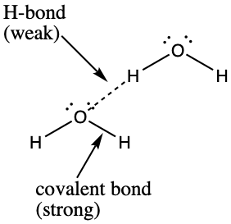 system, the energetics of collisions are such that all interactions between neighboring molecules are eventually broken, and the molecules move away from one another. When they to collide with one another, they (generally) do not adhere; the bond that might form between them is not strong enough to resist the kinetic energy delivered by collisions with other molecules. The molecules are in a gaseous state and the transition from liquid to gas is the boiling point. Similarly, starting with a liquid, when we reduce the system temperature, the interactions between molecules become longer lasting until a temperature is reached at which the energy transferred through collisions is no longer sufficient to disrupt the interactions between molecules.[228] As more and more molecules interact, the positions of neighboring molecules become more highly constrained - the liquid transitions into a solid. Because neighboring molecules in a liquid can move with respect to one another, liquids flow and assume the shape of their containers. Solids, in contrast, maintain their shape – neighboring molecules stay put. The temperature at which a liquid changes to a solid is known as its melting point. These temperatures mark what are known as phase transitions: solid to liquid and liquid to gas.
At the macroscopic level, we see the dramatic effects of bond polarity on melting and boiling points by comparing molecules of similar size with and without polar bonds and  the ability to form H-bonds (↓). For example, CH4(methane) or Ne (neon) do not contain polar bonds and so do not form intra-molecular H-bonds. In contrast NH3 (ammonia), H2O (water), and FH (hydrogen fluoride) have three, two and one polar bonds, respectively, and so can take part in one or more intra-molecular H-bonds. All five compounds have the same number of electrons, ten. When we look at their melting and boiling point temperatures, we see how the presence of polar bonds influences these properties. In particular, water stands out as dramatically different from the rest, with significantly higher (> 70ºC) melting and boiling points than its neighbors.
Why is water so different?
 In addition to the presence of polar covalent bonds, we have to consider a molecule's shape. Each water molecule has two partially positive H atoms and two partially negative regions on its O atom. These sites of potential H-bonds are arranged in a nearly tetrahedral geometry (→). Because of this arrangement, each water molecule can interact through H-bonds, with four neighboring water molecules. To remove a molecule from its neighbors, four H-bond-type electrostatic interactions must be broken, which is relatively easy, energetically, since they are each rather weak. In the liquid state, molecules jostle one another and change their H-bonded interaction partners constantly. Even if one or two interactions are broken the water molecule is likely to remain linked to multiple neighbors via the remaining H-bonds.
 This molecular hand-holding leads to water's comparatively high melting and boiling points as well as its high surface tension. We can measure the strength of surface tension in various ways. The most obvious is the weight that the surface can support. Water's surface tension has to be dealt with by organisms that interact with a liquid-gas interface. Some, like the water strider, use it to cruise along the surface of ponds (←). For the water strider to "walk" on the water surface the molecules of its feet cannot form H-bonds, they are said to be hydrophobic. That is clearly a bad name - they are not afraid of water, rather they are apathetic to it. Hydrophobic molecules interact with other molecules, including water molecules only through LDF-mediated interactions. Molecules that can make H-bonds or other polar interactions with water are termed hydrophilic. As molecules increase in size they can have both hydrophobic and hydrophilic regions. Molecules with distinct hydrophobic and hydrophilic regions are termed amphipathic; we consider them in the next chapter.
References
[228] The nature of the geometric constrains on inter-molecular interactions will determine whether the solid is crystalline or amorphous. see: https://en.wikipedia.org/wiki/Crystal
This page titled 5.9: The implications of bond polarity was last modified on Thu, 08 Jan 2026 23:35:44 GMT and is shared under a CC BY-NC-SA 4.0 license and was authored, remixed, and/or curated by Michael W. Klymkowsky and Melanie M. Cooper.
The book could not be loaded just now.