Opening the book…
Both carriers and channels allow the movement of molecules across a membrane, but there is a net directional flux only when a concentration gradient is present - that is, if the concentration of the molecule is different on the two sides of the membrane. If a membrane contains active channels and carriers (as all biological membranes do) concentration gradients across the membrane will dissipate. The [molecule X]outside will become equal to [molecule X]inside. Removing a concentration gradient across a cell’s plasma membrane is a good way to kill the cell. When we look at cells we find lots of concentration gradients, which raises the question, what produces and maintains these gradients. The common sense, thermodynamically correct answer is that there must be molecules (generally proteins) that can transport specific types of molecules across the membrane and against a concentration gradient. We will call these types of molecules pumps and write the reaction they are involved in as: \[[\text { Molecule }]_{\text {low concentration }}+\text { pump } \text { ↔ }[\text { Molecule }]_{\text {high concentration }}+\text { pump }\nonumber\]
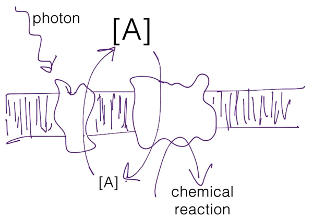 As you might suspect moving this reaction to the right is thermodynamically unfavorable; like a familiar macroscopic pump, it will require the input of energy to work. We will have to “plug in” our molecular pump into a source of energy in order to move a molecule against its concentration gradient. So, what energy sources are available? We have two choices: the system can use electromagnetic energy (light) or it can use chemical energy. In a light-driven pump, there is a system that absorbs photons (←); the photon's energy is coupled to the pumping system. Where the pump is driven by a chemical reaction a thermodynamically favorable reaction (←), catalyzed by the pump, is coupled to the movement of one or more molecules against their membrane-associated concentration gradients.
A number of chemical reactions can be used to drive such pumps and pumps can drive various reactions (remember reactions can move in both directions). One of the most common reactions involves the movement of energetic electrons through a membrane-bound, protein-based “electron transport” system; leading to the creation of an H+ based electrochemical gradient. The thermodynamically favorable movement of H+ "down" the concentration gradient can be coupled, through a membrane-bound ATP synthase enzyme, to a reaction that leads to the synthesis of adenosine triphosphate (ATP):
\[\begin{aligned}
&\mathrm{H}^{+}_{(\text {extracellular })} \rightleftharpoons \mathrm{H}^{+}_{(\text {intracellular })}\\
&\text {ATP synthase (membrane-localized catalyst of intracellular reaction) }\\
&\mathrm{H}^{+}+\text {adenosine diphosphate }(A D P)+\text { phosphate } \rightleftharpoons \text { adenosine triphosphate }(A T P)+\mathrm{H}_2 \mathrm{O}
\end{aligned}\nonumber\]
In the cytoplasm ADP, phosphate and H+ react resulting in the release ATP and water. The thermodynamically favorable movement of H+ down its concentration gradient is coupled to the thermodynamically unfavorable ATP synthesis reaction.
The reaction can also run in reverse, so that the thermodynamically favorable ATP hydrolysis reaction drives the export of H+.
\[\begin{aligned}
&A T P+\mathrm{H}_2 \mathrm{O} \rightleftharpoons A D P+\text { phosphate }+\mathrm{H}^{+}\\
&\text {ATPase-driven pump (ATP synthase running "backward") }\\
&\mathrm{H^+}_{(\text {intracellular })} \rightleftharpoons \mathrm{H^+}_{(\text {extracellular })}
\end{aligned}\nonumber\]
The same membrane protein, the ATP synthase/pump, makes it possible to use energy present in a chemical gradient (across a membrane) to drive ATP synthesis within the cell and can enable ATP hydrolysis to generate a concentration gradient.
This page titled 6.5: Generating gradients- using coupled reactions and pumps was last modified on Thu, 08 Jan 2026 23:36:12 GMT and is shared under a CC BY-NC-SA 4.0 license and was authored, remixed, and/or curated by Michael W. Klymkowsky and Melanie M. Cooper.
The book could not be loaded just now.