Opening the book…
Case Study: The Salton Sea
History
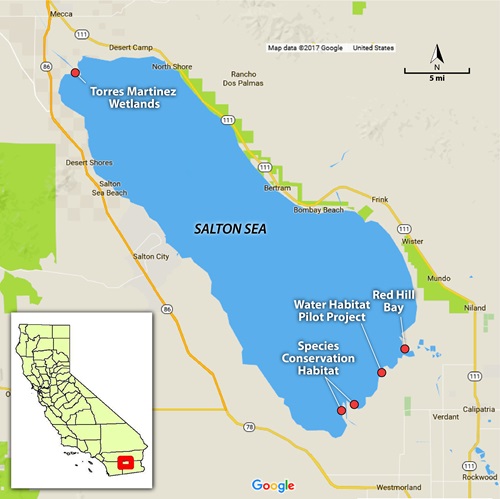
The Salton Sea is California's largest lake (35 miles long by 15 miles wide), located in the Sonoran Desert of southeastern California within the Imperial and Coachella Valleys (figure \(\PageIndex{a}\)). Unlike most lakes, the Salton Sea has no natural outlet. Water leaves the lake primarily through evaporation, causing dissolved salts and other substances to accumulate over time.
Although the modern Salton Sea formed in 1905, the basin has a long geologic history of periodically filling with water. For thousands of years, flooding from the Colorado River occasionally created a large freshwater lake known as Lake Cahuilla, which at times covered much of the present-day Imperial and Coachella Valleys. Lake Cahuilla eventually dried when the Colorado River changed course, leaving behind a dry lakebed known as the Salton Basin.
The modern Salton Sea was created accidentally in 1905 when flooding on the Colorado River breached irrigation works associated with the Imperial Canal and diverted the river's flow into the low-lying Salton Basin for nearly two years. By the time engineers stopped the flow in 1907, a large inland lake had once again formed in the desert.
For much of the twentieth century, the Salton Sea was sustained by agricultural runoff from surrounding farms. Water from the Colorado River, delivered through irrigation canals, flowed onto agricultural fields and eventually drained into the lake. These inflows helped maintain water levels and created habitat for millions of migratory birds traveling along the Pacific Flyway. The Salton Sea also supported recreational activities including boating, fishing, and tourism, making it a popular destination during the 1950s and 1960s.
The Shrinking Salton Sea
Beginning in the late twentieth century, water conservation measures and water-transfer agreements reduced the amount of agricultural runoff entering the lake. As inflows declined, evaporation exceeded water inputs and the lake began to shrink. Falling water levels exposed large areas of previously submerged lakebed known as playa (figure \(\PageIndex{b}\).

Ecological Impacts
As the Salton Sea contracts, its salinity continues to increase. Today, the lake is considerably saltier than the Pacific Ocean. Rising salinity has reduced fish populations and altered the food webs that support migratory birds. Large fish die-offs and harmful algal blooms have become increasingly common, further degrading water quality and wildlife habitat.
The decline of the Salton Sea also threatens one of California's most important remaining wetland ecosystems. As wetlands throughout the western United States have been drained or developed, the Salton Sea has become a critical stopover and wintering habitat for migratory birds along the Pacific Flyway. Continued habitat loss could negatively affect numerous bird species that depend on the lake during migration (figure \(\PageIndex{c}\)).

Human Health and Environmental Justice
The shrinking shoreline has also created significant human health concerns. Winds can lift fine sediments from the exposed playa and transport dust into nearby communities. These dust particles may contain salts, pesticides, and other contaminants that accumulated in lake sediments over decades. Exposure to airborne dust has been linked to respiratory illnesses, including asthma.
Many communities surrounding the Salton Sea are economically disadvantaged and have been disproportionately affected by declining environmental conditions and poor air quality. As a result, the Salton Sea is often cited as an example of an environmental justice issue, where environmental burdens are not distributed equally among populations.
Restoration Challenges and Lessons Learned
Recognizing these concerns, California agencies have initiated restoration projects aimed at reducing dust emissions, creating wetland habitat, and improving ecological conditions around the lake. However, restoration remains challenging because of competing demands for Colorado River water, prolonged drought, climate change, and the large scale of environmental degradation.
The Salton Sea illustrates how water-management decisions can have unintended ecological and social consequences. A water system originally developed to support agriculture created a valuable aquatic ecosystem, but changes in water use have led to declining water levels, increasing salinity, habitat loss, and public health concerns. The Salton Sea serves as a powerful example of how altering the movement of water across a landscape can transform both ecosystems and human communities for generations.
Think About It: Water-management decisions often involve tradeoffs among agriculture, urban water supplies, ecosystem health, and public well-being. Based on the strategies discussed in this chapter, what combination of conservation, potable water reuse, groundwater recharge, habitat restoration, and policy changes might help address the challenges facing the Salton Sea while balancing the needs of people and wildlife?
This page titled 10.4: Case Study - The Salton Sea was last modified on Fri, 09 Oct 2026 18:56:25 GMT and is shared under a CC BY-NC-SA 4.0 license and was authored, remixed, and/or curated by Erin Rempala via source content that was edited to the style and standards of the LibreTexts platform.
The book could not be loaded just now.