Opening the book…
Wind Energy
Wind energy is generated from the movement of air, which is ultimately driven by uneven heating of Earth's surface by the Sun. As warm air rises and cool air sinks, differences in air pressure create wind. Wind turbines capture the kinetic energy of moving air and convert it into electricity (figure \(\PageIndex{a}\)).
The blades of a wind turbine function similarly to airplane wings. As wind flows across the blades, differences in air pressure cause the rotor to spin. The rotor is connected to a generator, either directly or through a gearbox that increases the rotational speed. As the rotor turns, magnets spin within coils of wire, generating electricity through electromagnetic induction. This is the same basic process used in coal-, natural gas-, hydroelectric-, and nuclear-powered generators.
Wind energy has become one of the fastest-growing sources of renewable electricity worldwide. In the United States, wind accounted for approximately 26% of new electricity-generating capacity added in 2025. Improvements in turbine design and declining costs have also made wind energy one of the least expensive sources of new electricity generation. In 2026, the levelized cost of electricity from onshore wind was estimated at approximately $26 to $54 per megawatt-hour globally and about $30 to $40 per megawatt-hour in the United States.
Note: Comparisons of energy costs often use the levelized cost of energy (LCOE), which estimates the average cost of generating electricity over a power plant's lifetime. While LCOE is useful for comparing technologies, it does not account for factors such as energy storage, transmission upgrades, grid reliability, or the variability of wind and solar resources. As a result, the overall cost of integrating renewable energy into the electrical grid may differ from its reported LCOE.

Types of Wind Turbines
Wind turbines vary in size, design, and location, but all convert the kinetic energy of moving air into electricity.
Onshore Wind Turbines
Onshore wind turbines are installed on land and are the most common type of wind energy technology (figure \(\PageIndex{b}\)). They are often grouped into large wind farms in areas with strong and consistent winds, such as grasslands, mountain passes, and agricultural regions. Onshore wind energy is currently one of the least expensive sources of new electricity generation in many parts of the world.
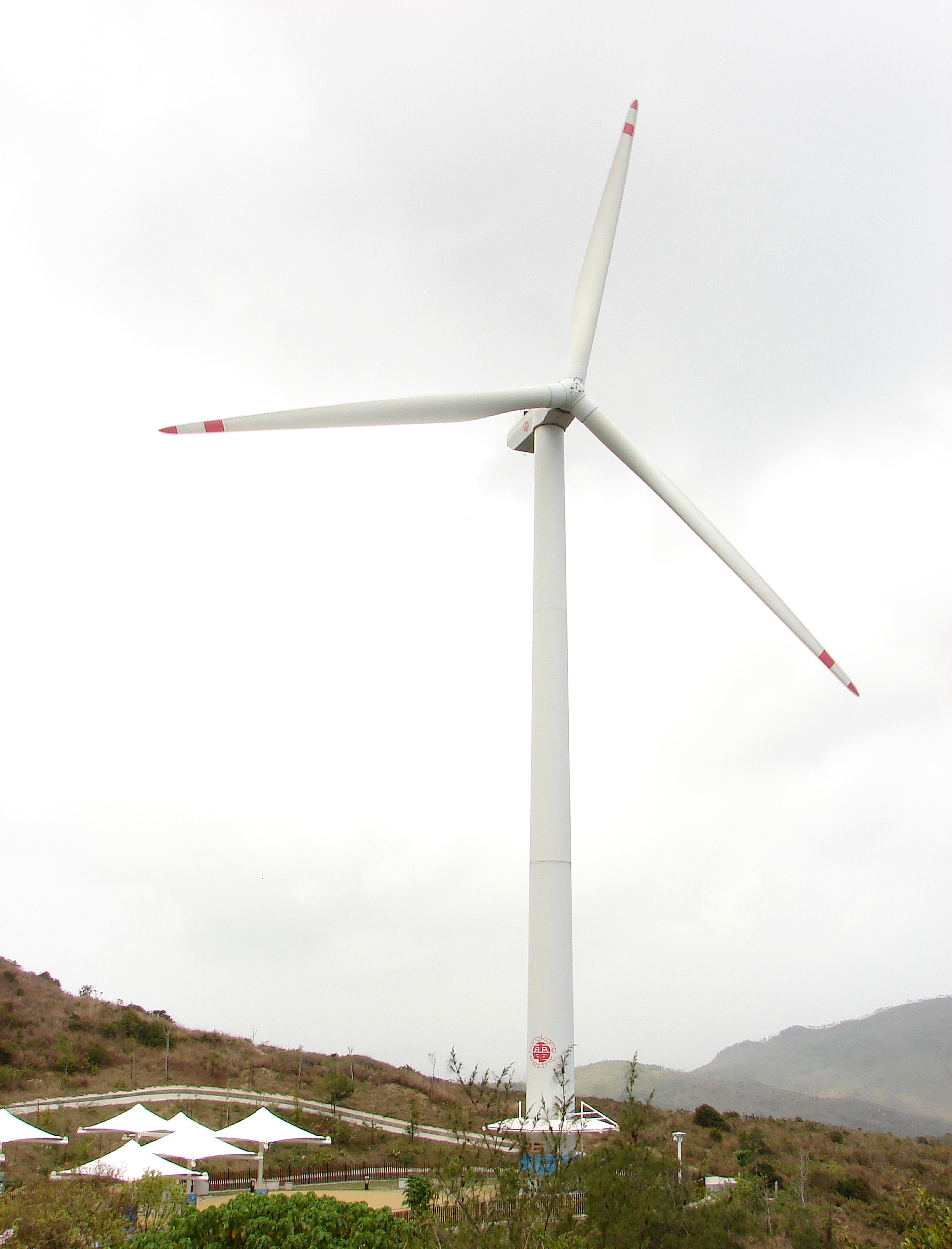

Figure \(\PageIndex{b}\): Left: The Nordex(opens in new window) N50 wind turbine. Right: visitor centre of Lamma Winds(opens in new window) in Hong Kong(opens in new window), China. By Patrickmak (opens in new window)- Own work, CC BY-SA 3.0, wikimedia.org(opens in new window) [commons.wikimedia.org]. Right image by Joshua Winchell/USFWS (public domain).
Onshore Wind Turbines
Onshore wind turbines are installed on land and are the most common type of wind energy technology (figure \(\PageIndex{c}\)). They are often grouped into large wind farms in areas with strong and consistent winds, such as grasslands, mountain passes, and agricultural regions. Onshore wind energy is currently one of the least expensive sources of new electricity generation in many parts of the world.

Figure \(\PageIndex{c}\): Top image: Thorntonbank Wind Farm(opens in new window), using REpower(opens in new window) 5M 5 MW turbines in the North Sea(opens in new window) off the coast of Belgium(opens in new window). By , CC BY-SA 4.0(opens in new window), wikimedia.org(opens in new window) [commons.wikimedia.org]. Bottom image: CGP(opens in new window) Grey(opens in new window) by CGP Grey(opens in new window) (CC-BY(opens in new window)).

Unconventional Wind Turbines
Some wind turbines use alternative designs that differ from the familiar three-bladed horizontal-axis turbine. Examples include vertical-axis wind turbines, counter-rotating turbines, and small turbines integrated into buildings, rooftops, or light poles (figure \(\PageIndex{d}\)). These designs are often used for small-scale or specialized applications and may be better suited to urban environments where wind direction changes frequently. However, they generally produce less electricity than large utility-scale wind turbines.


Figure \(\PageIndex{d}\): Top: Counterrotating turbine animation by Wikideas1(opens in new window) - Own work, CC BY-SA 4.0(opens in new window). Bottom left: Vertical-axis offshore wind turbine(opens in new window) animation by Wikideas1(opens in new window) - Own work, CC BY-SA 4.0(opens in new window). Bottom right: a light pole turbine (opens in new window)animation by Wikideas1(opens in new window) - Own work, CC BY-SA 4.0(opens in new window).


Advantages of Wind Energy
Wind energy is one of the lowest-cost sources of new electricity generation, and the expansion of wind power creates jobs in manufacturing, construction, installation, and maintenance (figure \(\PageIndex{e}\)). Because wind turbines generate electricity without burning fuel, they produce little air pollution and emit very little greenhouse gas over their lifetimes compared to fossil fuel power plants.
Unlike thermoelectric power plants that burn coal, natural gas, or use nuclear fission, wind turbines require little water to operate. This reduces water consumption and avoids the thermal pollution associated with power plant cooling systems.
Wind turbines also have a relatively small physical footprint. Although wind farms may occupy large areas of land, most of the space between turbines can still be used for agriculture or grazing. This can provide an additional source of income for farmers and ranchers while allowing working landscapes to remain intact.
Offshore wind farms may offer additional advantages because winds over oceans and large lakes are often stronger and more consistent than winds over land. As a result, offshore turbines can generate more electricity under favorable conditions. In some locations, offshore wind development may also reduce conflicts with agriculture and other land uses.


Disadvantages of Wind Energy
Wind energy has several challenges. Most importantly, wind turbines can generate electricity only when sufficient wind is available. Because wind speeds change over time, wind power is intermittent, meaning that electricity production can fluctuate from hour to hour and season to season. These variations can be reduced by connecting wind farms across large geographic areas, storing excess energy in batteries or other storage systems, and combining wind power with other energy sources. However, these solutions require additional infrastructure and can increase costs.
Some people also view wind turbines as visually intrusive, particularly in scenic landscapes, and others object to the noise produced by rotating blades. Although modern turbines are generally quieter than earlier designs, concerns about noise and aesthetics can influence public support for wind energy projects.
Wind turbines can affect wildlife, particularly birds and bats that collide with turbine blades. However, wind energy accounts for only a small fraction of human-caused bird mortality. Buildings, vehicles, power lines, domestic cats, and habitat loss kill far more birds each year than wind turbines. Careful site selection, turbine design, and operational practices can further reduce wildlife impacts. When the broader environmental effects of fuel extraction, air pollution, and climate change are considered, wind energy generally has a smaller overall ecological impact than fossil fuel energy sources.
Like all forms of energy production, wind power requires materials, land, and infrastructure. Constructing turbines, roads, transmission lines, and concrete foundations consumes energy and raw materials and can alter local habitats. Although these impacts are generally smaller than those associated with fossil fuel extraction and combustion, they should still be considered when evaluating the sustainability of wind energy.
No energy source is without environmental impacts. Wind energy reduces greenhouse gas emissions and air pollution compared to fossil fuels, but it can affect wildlife, landscapes, and land use. Evaluating sustainability requires considering both the benefits and drawbacks of each energy source and comparing their overall impacts across environmental, social, and economic dimensions.
Attribution
This page was heavily revised and rewritten by Erin Rempala and contains adapted content from content originally authored by Melissa Ha and Rachel Schleiger and is licensed CC BY-NC-SA 4.0.
Modified by Melissa Ha from the following sources:
- Renewable Energy(opens in new window) and Challenges and Impacts of Energy Use from Environmental Biology by Matthew R. Fisher (licensed under CC-BY(opens in new window))
- The Power of Wind(opens in new window). Office of Energy Efficiency and Renewable Energy. U.S. Department of Energy. Accessed 01-17-2021 (public domain).
This page titled 7.3.2: Wind Energy was last modified on Fri, 11 Sep 2026 18:37:58 GMT and is shared under a CC BY-NC-SA 4.0 license and was authored, remixed, and/or curated by Melissa Ha and Rachel Schleiger (ASCCC Open Educational Resources Initiative) .
The book could not be loaded just now.