Opening the book…
One of the most concentrated acids in the body is stomach acid, which can be approximated as a 0.05 M hydrochloric acid solution. Special cells in the stomach wall secrete this acid, along with special enzymes, as part of the digestion process. In a laboratory, a 0.05 M solution of hydrochloric acid would dissolve some metals. How does the stomach survive the presence of such a reactive acid?
Actually, the stomach has several mechanisms for withstanding this chemical onslaught. First, the lining of the stomach is coated with a thin layer of mucus that contains some bicarbonate ions (HCO3−). These react with the hydrochloric acid to produce water, carbon dioxide, and harmless chloride ions. If any acid penetrates through the mucus, it can attack the surface layer of stomach cells, called the gastric epithelium. Cells in the gastric epithelium are being constantly shed, so damaged cells are quickly removed and replaced with healthy cells.
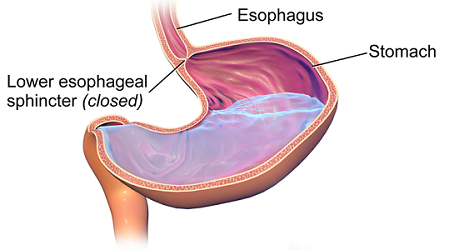 Figure \(\PageIndex{1}\): Stomach with acidic digestive juices. (CC BY-SA 4.0; BruceBlaus).
However, if the gastric epithelium is destroyed faster than it can be replaced, the acid may reach the wall of the stomach, resulting in ulcers. If an ulcer grows large enough, it can expose blood vessels in the stomach wall, causing bleeding. In extreme situations, the loss of blood through a severe ulcer can threaten a person’s health.
Ulcers can also result from the presence of a certain bacterium—Helicobacter pylori—in the stomach. The mechanism for this ulcer formation is not the same as that for ulcers caused by stomach acid and is not completely understood. However, there are two main treatments for ulcers: (1) antacids to react chemically with excess hydrochloric acid in the stomach and (2) antibiotics to destroy the H. pylori bacteria in the stomach.
This page titled 10.1: Prelude to Acids and Bases was last modified on Fri, 19 Sep 2025 20:45:44 GMT and is shared under a CC BY-NC 4.0 license and was authored, remixed, and/or curated by Staff via source content that was edited to the style and standards of the LibreTexts platform.
The book could not be loaded just now.