Opening the book…
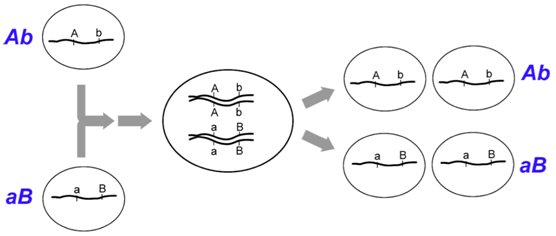
Having considered unlinked loci above, let us turn to the opposite situation, in which two loci are so close together on a chromosome that the parental combinations of alleles always segregate together (Figure \(\PageIndex{3}\)). This is because during meiosis they are so close that there are no crossover events between the two loci and the alleles at the two loci are physically attached on the same chromatid and so they always segregate together into the same gamete. In this case, no recombinants will be present following meiosis, and the recombination frequency will be 0%. This is complete (or absolute) linkage and is rare, as the loci must be so close together that crossovers are never detected between them.
This page titled 8.3: Linkage Reduces Recombination Frequency was last modified on Sat, 23 Aug 2025 14:18:25 GMT and is shared under a CC BY-SA 3.0 license and was authored, remixed, and/or curated by Todd Nickle and Isabelle Barrette-Ng via source content that was edited to the style and standards of the LibreTexts platform.
The book could not be loaded just now.