Opening the book…
Clearly, membrane proteins themselves have domains that keep membranes in or attached to the membrane, provide catalytic surfaces and allow interactions inside, across and outside of cells and organelles. Membranes anchor proteins in several ways. As noted, membrane proteins, like phospholipids, are amphipathic, with hydrophobic domains that non-covalently interact strongly with the fatty acid interior of membranes. Some integral membrane proteins span the entire membrane, with hydrophilic domains facing the cytosol or cell exterior. Peripheral proteins bind to a membrane surface through non-covalent interactions. Examples of integral and peripheral membrane proteins, glycoproteins and lipoproteins are illustrated below.
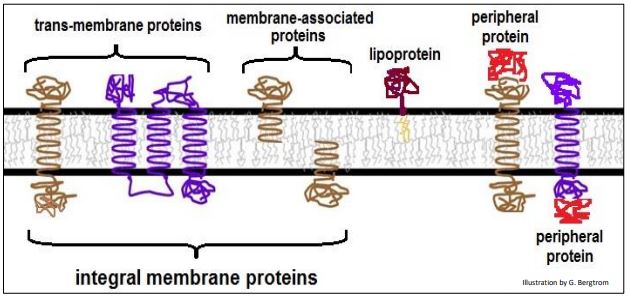
286 Domains of Membrane Proteins
This page titled 16.3: Membrane Proteins was last modified on Sun, 03 Jan 2021 21:47:23 GMT and is shared under a CC BY license and was authored, remixed, and/or curated by Gerald Bergtrom via source content that was edited to the style and standards of the LibreTexts platform.
The book could not be loaded just now.