Opening the book…
Name _____________
Data and Observations

S: Susceptible R: Resistent
Post Lab Questions
- What is the difference between a confluent lawn and confluent growth as seen in the first or second area of a t-streak? Why is a lawn important for this particular test?
2. As you will see in your results, most organisms are inhibited to some degree by the antibiotics. The question is: “Does this agent inhibit the organism to the extent that the antibiotic would be useful clinically?” To determine if the organism is clinically susceptible or resistant to each antibiotic you must do what two things?
3. Which antibiotic was most effective for each organism?
4. Classify each antibiotic used in this exercise by its general mechanism of action listed below. Interferes with bacterial cell wall formation. Targets the bacterial ribosome Interferes with bacterial DNA synthesis Interferes with folic acid synthesis Targets the bacterial plasma membrane
5. Is there a correlation between the mechanism of action of each antibiotic and its effect on Gram positive versus Gram negative organisms? Explain.
6. Explain why an antibiotic with a greater zone of inhibition, may not be the best choice to treat an infection.
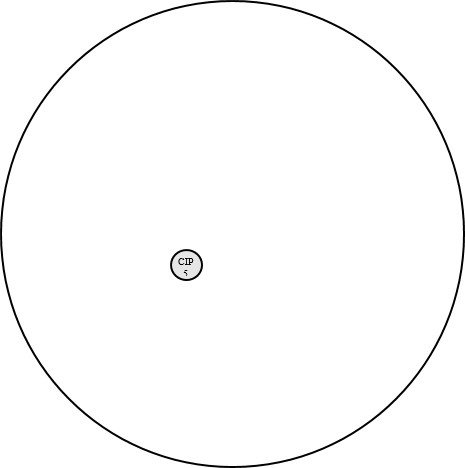
7. The large circle to the right represents an Agar plate and the small circle represents a disc infused with ciprofloxacin 5 µg. Draw the result after incubation if the organism is susceptible to the drug. Shade the area of the plate that would show growth. Then label the location where the MIC is reached.
8. Which area(s) have a drug concentration lower than MIC?
9. Which area(s) have a drug concentration higher than MIC?
This page titled Lab 27: Antibiotic Susceptibility Assignment was last modified on Sun, 06 Sep 2026 18:39:36 GMT and is shared under a CC BY 4.0 license and was authored, remixed, and/or curated by Emilie Miller (OpenOregon) via source content that was edited to the style and standards of the LibreTexts platform.
The book could not be loaded just now.