Opening the book…
Microorganisms can reduce ferric iron \((\text{Fe(III)})\) to ferrous iron \((\text{Fe(II)})\) for dissimilatory or assimilatory purposes. Assimilatory iron reduction provides iron needed to form proteins that are then used to build some essential enzymes (Ferousi et al., 2017; Schröder et al., 2003). In fact, Ferousi et al. (2017) notes that iron is the most abundant transition metal in organisms. Reflecting this need, some microorganisms can also store iron in the form of ferritin and bacterioferritin (Andrews, 1998).
Dissimilatory iron reduction typically occurs in anoxic environments that lack nitrate. Electron donors that can be used by iron-reducing microorganisms include simple organics and dihydrogen \(\left(\text{H}_{2}\right)\) (Weber et al., 2006). In addition, ferric iron can also be reduced by reacting with sulfide or reduced humic substances (Canfield, 1989; Lovley et al., 1996; Pyzik and Sommer, 1981; Roden et al., 2010). The sulfide and reduced humic substances that can reduce ferric iron are often products of microbial reactions. However, reduction of iron by these compounds is typically referred to as abiotic iron reduction because the iron reduction reaction itself is not directly catalyzed by microorganisms.
At pH greater than 3, ferric iron solubility is low (Bird et al., 2011). Thus, instead of respiring dissolved ferric iron, the ferric iron available for dissimilatory metabolism commonly exists as a solid phase, including ferric hydroxide, oxide, and oxyhydroxide phases, which are hereafter referred to as (oxyhydr)oxide minerals. In addition to these minerals, microorganisms can also reduce ferric iron in some clay minerals (Dong et al., 2009). The following example reactions include acetate as the electron donor and some common (oxyhydr)oxide minerals (hematite \(\left(\text{Fe}_{2} \text{O}_{3}\right)\), goethite \(\left(\text{FeOOH}\right)\), ferrihydrite (approximated here as \(\text{Fe(OH)}_{3}\)):
\[\begin{align} & \text{CH}_{3} \text{COO}^{-} + 15 \ \text{H}^{+} + 4 \ \text{Fe}_{2} \text{O}_{3} \longleftrightarrow 2 \ \text{HCO}_{3}^{-} + 8 \ \text{H}_{2} \text{O} + 8 \ \text{Fe}^{2+} \\ & \text{CH}_{3} \text{COO}^{-} + 15 \ \text{H}^{+} + 8 \ \text{FeOOH} \longleftrightarrow 2 \ \text{HCO}_{3}^{-} + 12 \ \text{H}_{2} \text{O} + 8 \ \text{Fe}^{2+} \\ & \text{CH}_{3} \text{COO}^{-} + 15 \ \text{H}^{+} + 8 \ \text{Fe(OH)}_{3} \longleftrightarrow 2 \ \text{HCO}_{3}^{-} + 20 \ \text{H}_{2} \text{O} + 8 \ \text{Fe}^{2+} \end{align}\]
In general, poorly crystalline phases such as ferrihydrite tend to have higher surface areas and solubilities than more stable phases, such as goethite and hematite. These differences can affect the rate at which microorganisms can use them as electron acceptors. Specifically, iron reduction rates have been found to increase with (oxyhdr)oxide surface area and solubility (Bonneville et al., 2009, 2004; Cutting et al., 2009; Larsen and Postma, 2001; Roden, 2006, 2003).
Reflecting these relationships, some previous studies have found that (oxhydr)oxide phases with high crystallinities, such as goethite and hematite, can only support small amounts of microbial iron reduction. However, ferric (oxyhydr)oxide reactivity varies widely, reflecting variation in mineral properties as well as environmental conditions (Konhauser et al., 2011). For example, recent laboratory studies found low rates of goethite reduction in bioreactors with basic pH but in complementary reactors with acidic pH, extensive goethite reduction occurred (Kirk et al., 2013; Marquart et al., 2019; Paper et al., 2021). These differences may reflect the influence of environmental pH on the free energy yield of goethite reduction as well as changes in reaction mechanisms, as discussed in chapters 8 and 10. Either way, the results show that environmental pH can influence the extent to which microorganisms can reduce highly crystalline (oxhydr)oxides. Caution should be taken in extending conclusions drawn from iron-reducing cultures with basic pH to systems with acidic pH.
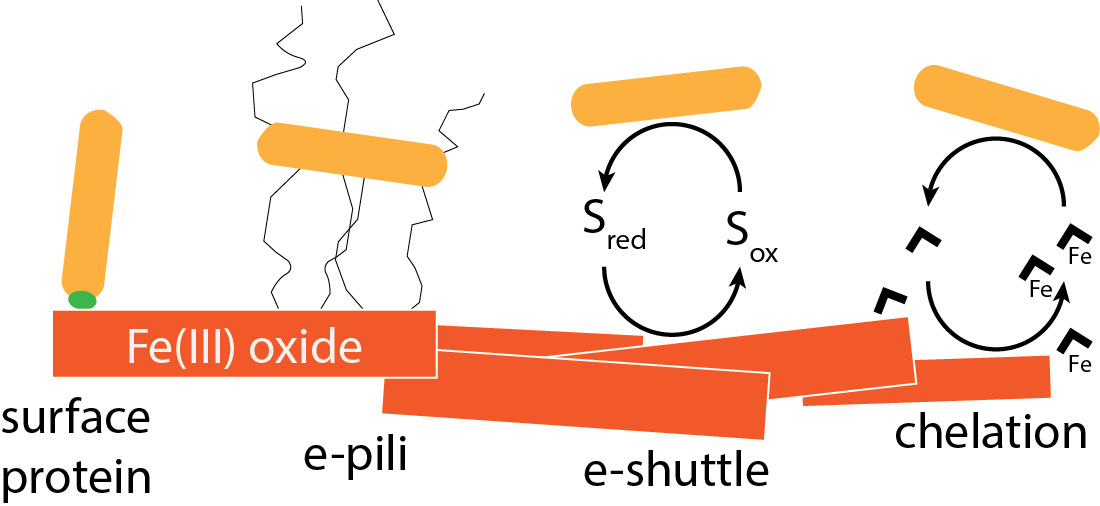
Solid-phase sources of ferric iron cannot be transported into the cell. Therefore, in order to use them as electron acceptors, iron-reducing microorganisms have to be able to transfer electrons outside of the cell. Microorganisms can transfer electrons externally through proteins on their surface, through electrically conductive pili (e-pili), by cycling electron shuttle compounds, and by forming chelators that solubilize ferric iron (Fig. \(5.5\)). Electron shuttle compounds include flavins, phenazines, and humic substances (Lovley and Holmes, 2021; Piepenbrock et al., 2014). The microorganism transfer electrons to the shuttle, which can then transfer the electrons to the mineral. Chelators are organic compounds that tightly bind to ferric iron and other metal ions, allowing them to become soluble.
https://commons.wikimedia.org/wiki/File:External_electron_transfer_strategies.png

Regardless of the mechanism, ferrous iron is ultimately produced by ferric iron reduction. Some of the ferrous iron may accumulate in solution, reflecting its high solubility compared to ferric iron. It can adsorb onto what remains of the ferric mineral and other minerals in the environment (Benner et al., 2002; Roden and Urrutia, 1999; Urrutia et al., 1999) (Fe(II)ads in Fig. \(5.4\)). It can also precipitate as a mineral. Example minerals that can form as a result of iron reduction include mackinawite \((\text{FeS})\) and other sulfide minerals, siderite \(\left(\text{FeCO}_{3}\right)\), vivianite \(\left(\text{Fe}_{3} \left(\text{PO}_{4}\right)_{2} \cdot 8 \ \text{H}_{2} \text{O}\right)\), and mixed-valence phases including magnetite \(\left(\text{Fe}_{3} \text{O}_{4}\right)\) and green rust. We will discuss further aspects of microbial mineral precipitation in Chapter 12.

Lastly, many different species of microorganisms are able to use ferric iron reduction as a source of energy (Hori et al., 2015; Lentini et al., 2012; Weber et al., 2006). Among the most widely studied are Geobacter metallireducens and Shewanella putrefaciens. Some microorganisms that can reduce iron can also use other electron acceptors including sulfur compounds and uranium (Holmes et al., 2004; Lovley et al., 1993). Some can also partner with methanogens and help produce methane via interspecies electron transfer (Rotaru et al., 2014a, 2014b). In this case, rather than transfer the electrons to a ferric iron mineral, the ‘iron reducer’ transfers electrons to a methanogen, which uses them to reduce carbon dioxide and make methane.
This page titled 5.3.1: Ferric iron reduction was last modified on Sun, 31 Mar 2024 22:37:18 GMT and is shared under a CC BY-SA 4.0 license and was authored, remixed, and/or curated by Matthew F Kirk via source content that was edited to the style and standards of the LibreTexts platform.
The book could not be loaded just now.