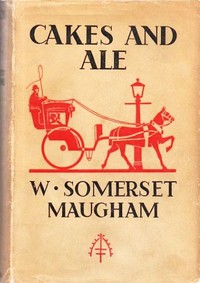
Cakes and ale
Cakes and Ale, or, The Skeleton in the Cupboard (1930) is a novel by the British author W. Somerset Maugham. Maugham exposes the misguided social snobbery levelled at the character Rosie Driffield, whose frankness, honesty, and sexual freedom make her a target of conservative opprobrium. Her character is treated favourably by the book's narrator, Ashenden, who understands that she was a muse to the many artists who surrounded her, and who himself enjoyed her sexual favours. Maugham drew his title from the remark of Sir Toby Belch to Malvolio in William Shakespeare's Twelfth Night: "Dost thou think, because thou art virtuous, there shall be no more cakes and ale?" Cakes and ale are also the emblems of the good life in Joseph Jacobs' 1912 rendition of Aesop's fable of "The Town Mouse and the Country Mouse": "Better beans and bacon in peace than cakes and ale in fear." In his introduction to a Modern Library edition, published in 1950, Maugham wrote, "I am willing enough to agree with common opinion that Of Human Bondage is my best work ... But the book I like best is Cakes and Ale ... because in its pages lives for me again the woman with the lovely smile who was the model for Rosie Driffield." (This summary is from Wikipedia.)
Summary written by Project Gutenberg, by machine.
- Language
- English
- On Project Gutenberg since
- 22 May 2026
- Read in the last 30 days
- 443 times at Project Gutenberg
More by W. Somerset Maugham
See all: More by W. Somerset Maugham
The Moon and Sixpence

Of Human Bondage
The Painted Veil

The Explorer
The Hero

The Trembling of a Leaf: Little Stories of the South Sea Islands
The Magician
On a Chinese Screen

Liza of Lambeth
Landed Gentry: A Comedy in Four Acts
Mrs. Craddock
Orientations
The Land of Promise: A Comedy in Four Acts
The Land of The Blessed Virgin; Sketches and Impressions in Andalusia

Plays: Lady Frederick, The Explorer, A Man of Honour

The Merry-go-round
The Circle: A Comedy in Three Acts
Jack Straw: A Farce in Three Acts
Cæsar's Wife: A Comedy in Three Acts