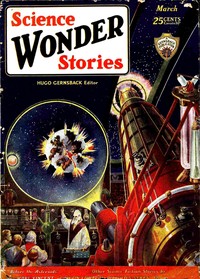
The color of space
Illustrated by Frank R. Paul
Human-made only is on in this browser, so Project Gutenberg's machine summaries are left out. Settings.
The color of space by Charles R. Tanner is a science fiction short story written in the early 20th century. It follows a kidnapped scientist confronted with a supposed Russian discovery that cancels gravity and enables spaceflight, exploring themes of deception, technological awe, and scientific skepticism. A Russian agent, Godonoff, abducts Dr. Henshaw to force him to sell a secret process. In a metal room with a huge circular window, Godonoff claims Russia has created “helium fluoride” that negates gravity, built giant rotating discs, and even stolen famous buildings for transport to Venus. He points out reflective shields, a solar engine, and gas jets, while a starry panorama shows Earth, the Moon, and the captured structures drifting past. Henshaw notices fatal errors: a blue, sparsely starred sky instead of black space crowded with stars, the lack of blinding solar glare from nearby metal, and an “airlock” door that opens easily despite the supposed vacuum outside. He steps through and finds an ordinary city street, escaping the staged illusion. Later he explains to reporters how simple physical facts exposed the hoax.
AI-generated Summary written by Project Gutenberg, by machine.
- Language
- English
- On Project Gutenberg since
- 3 January 2026
- Read in the last 30 days
- 350 times at Project Gutenberg