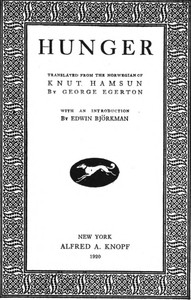
Hunger
by Knut Hamsun
Introduction by Edwin Björkman · Translated by George Egerton
"Hunger" by Knut Hamsun is a novel written in the late 19th century. It is a stark, psychologically intimate portrait of a destitute young writer wandering Christiania, tracing his pride, imagination, and desperation as hunger frays his mind. The focus is less on plot than on a vivid inner life—restless thoughts, sudden exaltations, and humiliations—rendered in intense, impressionistic prose. The opening of the novel follows an unnamed aspiring writer as he wakes in a bare attic, broke and hungry, and drifts through Christiania trying to write, find work, and keep his dignity. He pawns his waistcoat to give a coin to a lame stranger, buys a meager meal, and oscillates between grand ideas (new essays and “philosophical” treatises) and erratic impulses (taunting a woman he dubs Ylajali, spinning lies for a credulous old man). He submits a literary sketch to a newspaper and clings to hope while dodging his landlady, then abandons his room and spends a cold, miserable night in the woods. Hunger sharpens and distorts his perceptions; small slights enrage him, and brief bursts of inspiration give way to emptiness. By the end of this opening, rebuffed for a bookkeeping job over a foolish date error, he is weakened and ashamed, yet still forcing a polite front as he tries to seize any chance—such as an advertised job helping an invalid—that might keep him going.
Summary written by Project Gutenberg, by machine.
- Language
- English
- On Project Gutenberg since
- 17 August 2025
- Read in the last 30 days
- 613 times at Project Gutenberg
More by Knut Hamsun
See all: More by Knut Hamsun
Hunger

Growth of the Soil

Markens grøde, Første del
Sult

Wanderers

Pan
Mothwise

Markens grøde, Anden del

Look Back on Happiness

Segen der Erde: Roman
Victoria

Shallow Soil

Sklaven der Liebe, und andere Novellen

Väriä ja viivoja: Werner von Heidenstamin, Oscar Levertinin y.m. novelleja

Hunger: Book One
Nälkä

Saban kuningatar sekä muita kertomuksia
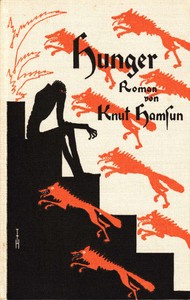
Hunger

Syystähden alla: Kulkijan kertomus
Éhség
More from the shelf “Nobel Prizes in Literature”
See all: More from the shelf “Nobel Prizes in Literature”
A farewell to arms
The Jungle Book

The Problems of Philosophy

The Lock and Key Library: Classic Mystery and Detective Stories: Modern English

The Phantom 'Rickshaw, and Other Ghost Stories

The Red Lily — Complete

Siddhartha

Pygmalion

Buddenbrooks: Verfall einer Familie

Quo Vadis: A Narrative of the Time of Nero

Tractatus Logico-Philosophicus

The Knights of the Cross, or, Krzyzacy: Historical Romance

Just so stories
The Sun Also Rises

Demian

Der Zauberberg. Erster Band
The Life of Joan of Arc, Vol. 1 and 2

The sound and the fury
Gitanjali