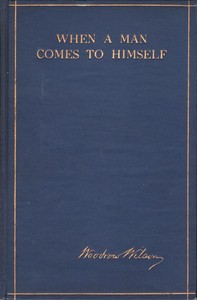
When a Man Comes to Himself
"When a Man Comes to Himself" by Woodrow Wilson is a philosophical essay written in the early 20th century. It explores the transformative experience a man undergoes when he comes to an awareness of his true self and purpose in life. The book reflects on the psychological and spiritual journey of self-discovery, emphasizing that this awakening can occur at various points in life and is essential for personal growth and responsibility. In the essay, Wilson discusses how a man finds his true place in the world through experiences that challenge his self-absorption and illuminate his capacities beyond mere personal ambition. He posits that true satisfaction arises not from self-indulgence, but from dedicating oneself to the service of others, encapsulating the idea that a meaningful life is grounded in relationships and responsibilities within a community. Through various examples, Wilson illustrates that the realization of one's powers and the commitment to unselfish love or service leads to a fulfilling existence. Ultimately, the essay serves as a reflection on the necessity of moral purpose and connection in achieving a contented life.
Summary written by Project Gutenberg, by machine.
- Language
- English
- On Project Gutenberg since
- 1 February 2004
- Read in the last 30 days
- 628 times at Project Gutenberg
More by Woodrow Wilson
See all: More by Woodrow Wilson
George Washington

The new freedom

Congressional government

President Wilson's Addresses

In our first year of war
On Being Human

State of the Union Addresses

Why we are at war

Abraham Lincoln
An old master, and other political essays

Mere literature, and other essays
The social center
The Road Away from Revolution
A history of the American people, Vol. 2 [of 5]

A history of the American people, Vol. 1 [of 5]

A history of the American people, Vol. 3 [of 5]

A history of the American people, Vol. 4 [of 5]