The origin of the family, private property, and the state
Translated by Gerhard Ernest Untermann
"The origin of the family, private property, and the state" by Friedrich Engels is an anthropological treatise published in 1884. Drawing on Karl Marx's notes and Lewis H. Morgan's research on ancient societies, Engels examines how human social organization evolved through distinct historical stages. The work explores the transition from matrilineal clans and primitive communism to patriarchal structures, arguing that the rise of private property fundamentally altered family dynamics and gender relations. Engels presents this shift as a pivotal transformation in human history, connecting economic developments with changes in power and social structure.
Summary written by Project Gutenberg, by machine.
- Language
- English
- On Project Gutenberg since
- 8 July 2010
- Read in the last 30 days
- 2,082 times at Project Gutenberg
More by Friedrich Engels
See all: More by Friedrich Engels
Der Briefwechsel zwischen Friedrich Engels und Karl Marx 1844 bis 1883, Erster Band
The Communist Manifesto
The Condition of the Working-Class in England in 1844

Manifesto of the Communist Party
Socialism, Utopian and Scientific

Feuerbach
Revolution and Counter-Revolution; Or, Germany in 1848
Landmarks of Scientific Socialism: "Anti-Duehring"
L'origine della Famiglia della Proprietà privata e dello Stato
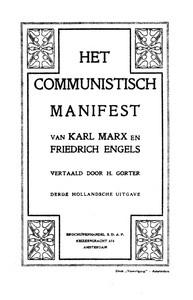
Het communistisch manifest