Feuerbach
With contributions by Karl Marx · Translated by Austin Lewis
"Feuerbach: The Roots of the Socialist Philosophy" by Friedrich Engels is a philosophical examination written in the late 19th century. The work explores the origins and foundational principles of socialist philosophy, particularly emphasizing the influence of Hegel and Feuerbach on Marx and Engels. It addresses the relationship between materialism and idealism, arguing for a radical materialist understanding of human history and societal development. At the start of the work, Engels introduces the historical context leading to the revolution of 1848, demonstrating how socialist thought emerged from the Hegelian tradition and the subsequent disintegration of that philosophy. He critiques Feuerbach’s idealism, highlighting its limitations and the necessity of grounding philosophy in materialism and concrete human experiences. Engels outlines that while Feuerbach's ideas contributed significantly to the evolution of socialist thought, his philosophical framework ultimately fell short of capturing the revolutionary potential that Marx and Engels would later advocate. This opening sets the stage for a detailed exploration of the dialectical method and materialistic conceptions of history that define the socialist movement.
Summary written by Project Gutenberg, by machine.
- Language
- English
- On Project Gutenberg since
- 15 January 2009
- Read in the last 30 days
- 953 times at Project Gutenberg
More by Friedrich Engels
See all: More by Friedrich Engels
Der Briefwechsel zwischen Friedrich Engels und Karl Marx 1844 bis 1883, Erster Band

The Communist Manifesto

The Condition of the Working-Class in England in 1844

The origin of the family, private property, and the state

Manifesto of the Communist Party
Socialism, Utopian and Scientific

Revolution and Counter-Revolution; Or, Germany in 1848

Landmarks of Scientific Socialism: "Anti-Duehring"
L'origine della Famiglia della Proprietà privata e dello Stato
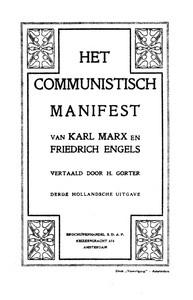
Het communistisch manifest