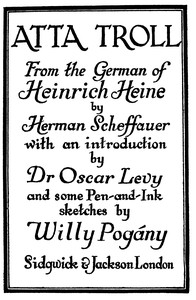
Atta Troll
Introduction by Oscar Levy · Illustrated by Willy Pogány · Translated by Herman George Scheffauer
"Atta Troll" by Heinrich Heine is a lyrical poem written in the early 19th century. This satirical work follows the titular character, Atta Troll, a dancing bear who represents the common people, as he escapes from human bondage and expresses his discontent with humanity's arrogance and inequality. The poem intertwines themes of social critique and romanticism, exploring ideas of freedom and the nature of existence through the lens of Heine's sharp wit and poignant observations. At the start of "Atta Troll," we are introduced to the bear's life in captivity, where he performs for human entertainment, despite the deep sorrow tied to his lost freedom. The narrative captures his tumultuous feelings toward his captors, conveying his anguish and rage at being reduced to a mere spectacle. Alongside Atta Troll, the story introduces Lascaro, a frail figure tied to the oppressive forces of feudalism, and his mother, the witch Uraka, who symbolizes the outdated traditions resisting change. This opening establishes a rich tapestry of characters and themes that set the stage for a thoughtful exploration of freedom, social justice, and the struggle against human arrogance.
Summary written by Project Gutenberg, by machine.
- Language
- English
- On Project Gutenberg since
- 17 February 2010
- Read in the last 30 days
- 891 times at Project Gutenberg
More by Heinrich Heine
See all: More by Heinrich Heine
The Prose Writings of Heinrich Heine

Poems and Ballads of Heinrich Heine
The poems of Heine; Complete

Die Harzreise
Buch der Lieder

Deutschland. Ein Wintermärchen
Almansor: Eine Tragödie

Das Lied vom blöden Ritter

Romanzero

Aikarunoja

Valikoima runoelmia

De Franse Pers
Franse Toestanden

De Beurs Lacht

Saksanmaa