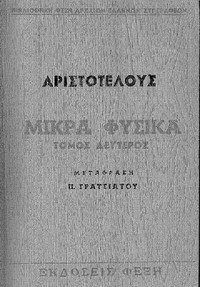
Μικρά Φυσικά, Τόμος Δεύτερος
by Aristotle
Translated by Paulos Gratsiatos
"Μικρά Φυσικά, Τόμος Δεύτερος" by Aristotle is a scientific publication likely written in the early centuries of the Common Era. This work focuses on various natural phenomena and human experiences, including the nature of dreams, their causes, and effects on perception, blending philosophy with empirical observation to understand sensory phenomena. The beginning of this volume explores the concept of dreams, asserting that they occur in the realm of the sensory rather than the rational part of the psyche. Aristotle begins by discussing how dreaming differs from sensory perception during wakefulness, emphasizing that while one may experience vivid imagery in dreams, they are not controlled by external stimuli in the same way as when awake. He proposes that dreams are residual impressions of prior sensory experiences, offering insights into the workings of perception and imagination during sleep. Additionally, Aristotle examines how emotional and physical states can influence dreaming, hinting at a complex interplay between the mind and body in these nocturnal narratives.
Summary written by Project Gutenberg, by machine.
- Language
- Greek (Ελληνικά)
- On Project Gutenberg since
- 26 January 2009
- Read in the last 30 days
- 435 times at Project Gutenberg
More by Aristotle
See all: More by Aristotle
The Nicomachean ethics of Aristotle

The Poetics of Aristotle

Aristotle on the art of poetry

Politics: A Treatise on Government

The Athenian Constitution

The Categories
Aristotle's History of Animals
Aristoteles' Poetik
Über die Dichtkunst beim Aristoteles
Αθηναίων Πολιτεία
Περί Ψυχής

Ηθικά Νικομάχεια, Τόμος Πρώτος

Μικρά Φυσικά, Τόμος Πρώτος
Ηθικά Νικομάχεια, Τόμος Δεύτερος
Runousoppi

Aristoteles' Zielkunde

Lehre vom Schluss