Window mode follows your eyes with your camera, in this browser only: no picture or position leaves your device.
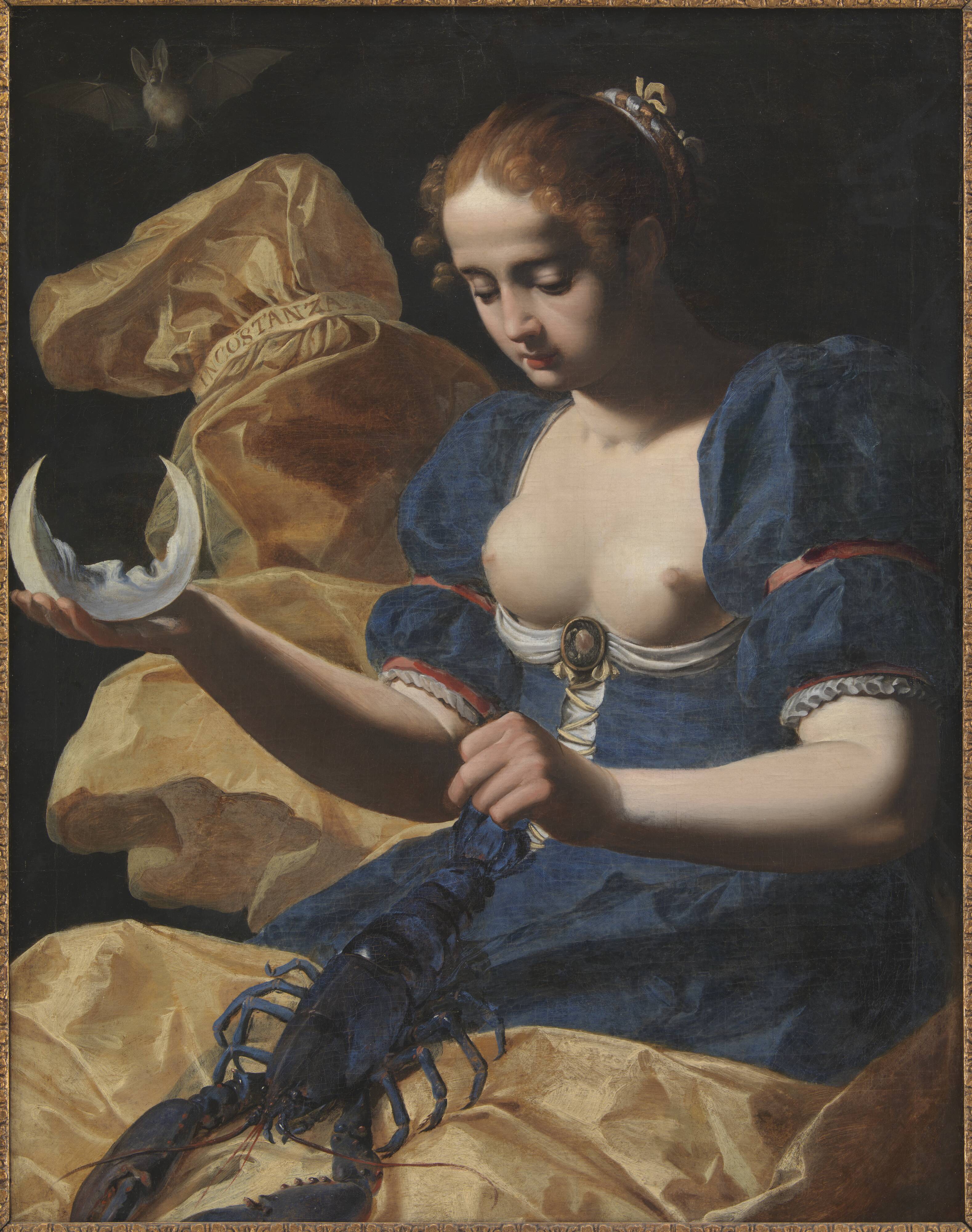
Incostanza. An Allegory of Fickleness
attributed to Abraham I Janssens (Flemish, 1567–1632)
earlier ascribed to Gerard van Honthorst (Dutch, 1592–1656)
earlier ascribed to Ubekendt hollandsk 1600-tallet (Dutch, 1600–1600)
1615-1618
- Medium
- Oil on canvas
- Classification
- Painting
- Dimensions
- height 106.5 cm, width 82 cm, height 127.5 cm, width 105.4 cm
- Culture
- Flemish
- Museum
- SMK – National Gallery of Denmark
- Rights
- Public Domain Mark: SMK waives its rights in this photograph, as the museum states it.
- Who can see it
- Teens profiles and older: its museum says too little about what it shows to place it for younger viewers. How works are placed
View at the SMK – National Gallery of Denmark
About this work
It is a strange motif. A young woman is holding a crescent moon in one hand and a blue lobster in the other. She does not seem to notice that her bosom is bared and that we are looking at her. The depiction shows "fickleness" in keeping with the era's code books of symbols in art, where the semi-clad woman, the ever-changing moon, and crustaceans - capable of walking sideways - serve as markers for those of a mercurial temperament. The artist, moved by a visual desire that we would now term voyeurism or fetishism, focuses intently on her breasts, which shine with a brightness even greater than that of the crescent-moon face she holds in her hand. The breasts are associated with other feminine characteristics: with bodily matters, impulsivity, and the subconscious as well as with fertility and pregnancy. The woman may be attractive, but she is also potentially dangerous. In contrast to the moon, the sun was typically a symbol of maleness and masculinity, i.e. of intelligence, will, exaltedness, and divinity.