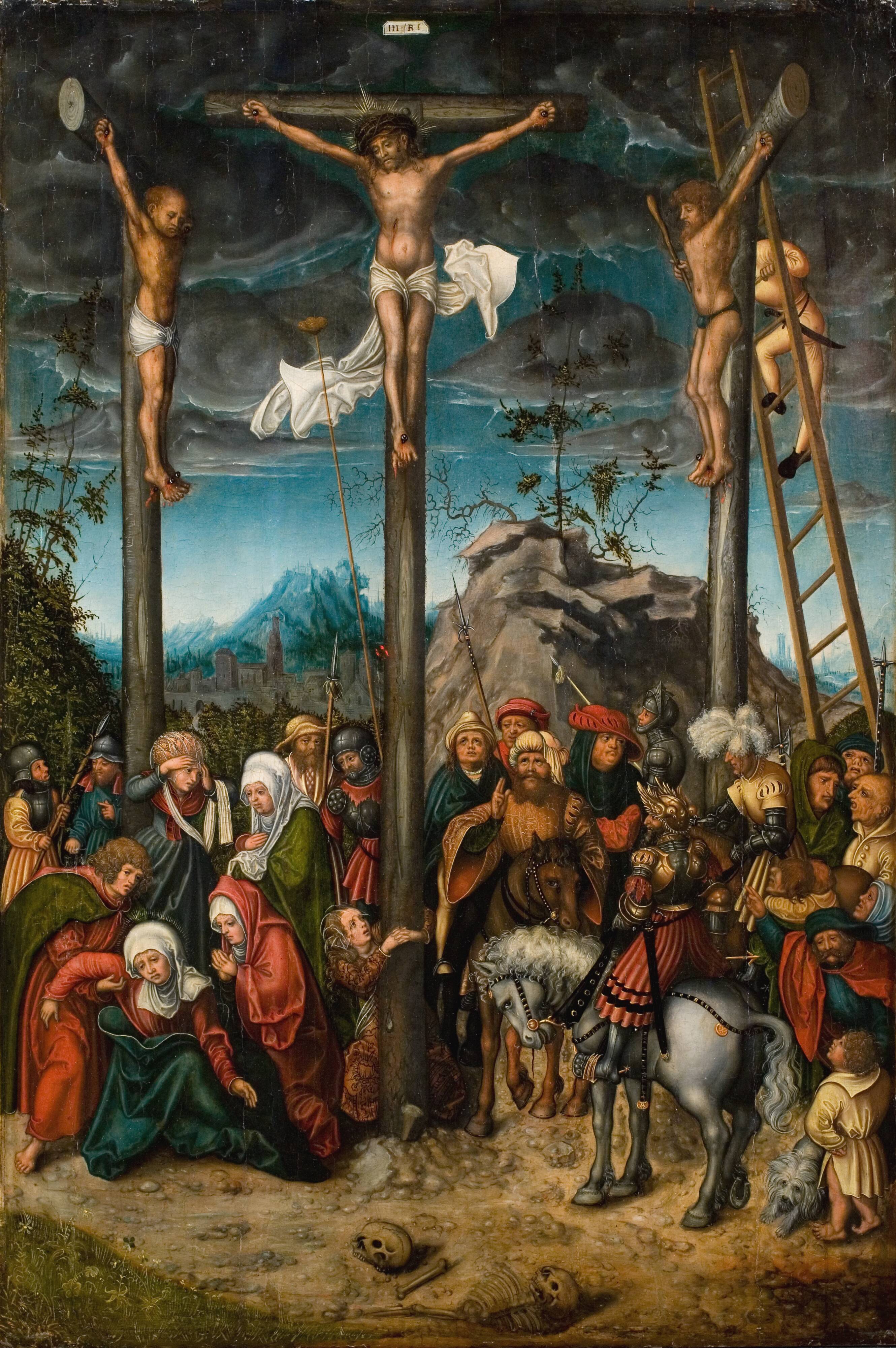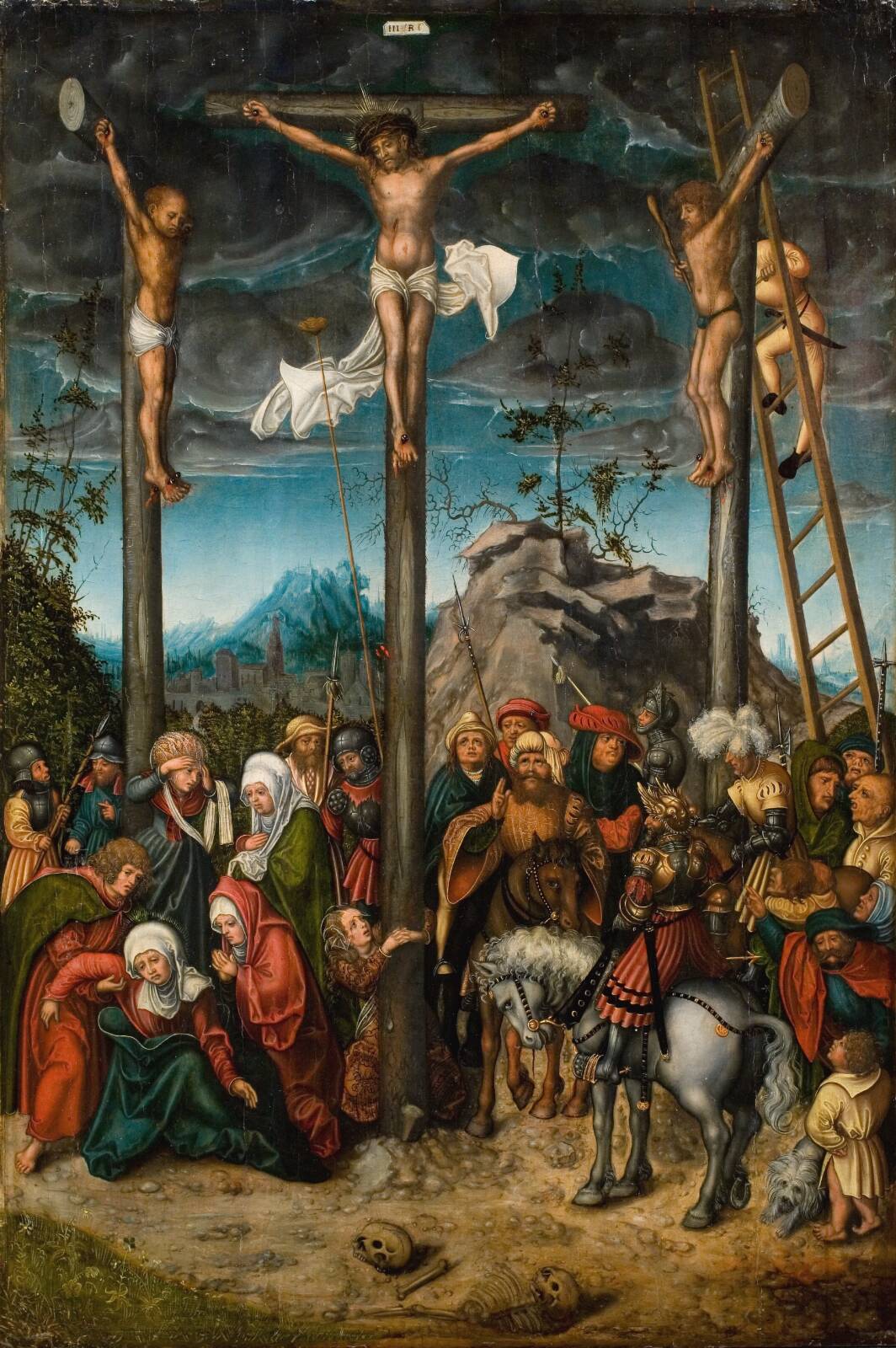
The Crucifixion
Lucas Cranach (I) (German, 1472–1553)
earlier ascribed to Albrecht Dürer (German, 1471–1528)
earlier ascribed to Michael Wolgemut (German, 1434–1519)
1513-1518
- Medium
- Oil on panel
- Classification
- Painting
- Dimensions
- height 67 cm, width 46.5 cm, height 78.5 cm, width 57.5 cm
- Culture
- German
- Museum
- SMK – National Gallery of Denmark
- Rights
- Public Domain Mark: SMK waives its rights in this photograph, as the museum states it.
- Who can see it
- Teens profiles and older: its subject is for older viewers (war, death, the Passion, drink or the like). How works are placed
View at the SMK – National Gallery of Denmark
About this work
Cranach produced countless representations of the Crucifixion, both before and after the Reformation. One of the most famous is that from 1503 in Munich (Alte Pinakothek, Bayerische Staatsgemäldesammlungen); it is a clearly pre-Reformation work on account of the almost physical obtrusiveness towards the viewer. Cranach’s late Crucifixions, and late works in general, are on the other hand tied to the surface of the picture and make no attempt to reproduce a convincing effect of reality. This Crucifixion is moving in the direction of this flat effect - it is, among other things this that produces the "stiffness" and the emblematic quality in the representation of figures - but it is still a spatial image that formally invites the viewer to participate in the scene. In addition, The Crucifixion is a good example of a motif that could be incorporated without problem into the Reformation repertoire. Luther greatly preferred the historical portrayal of the Crucifixion rather than the iconic in which the Crucifixion is isolated outside time and place.