Window mode follows your eyes with your camera, in this browser only: no picture or position leaves your device.
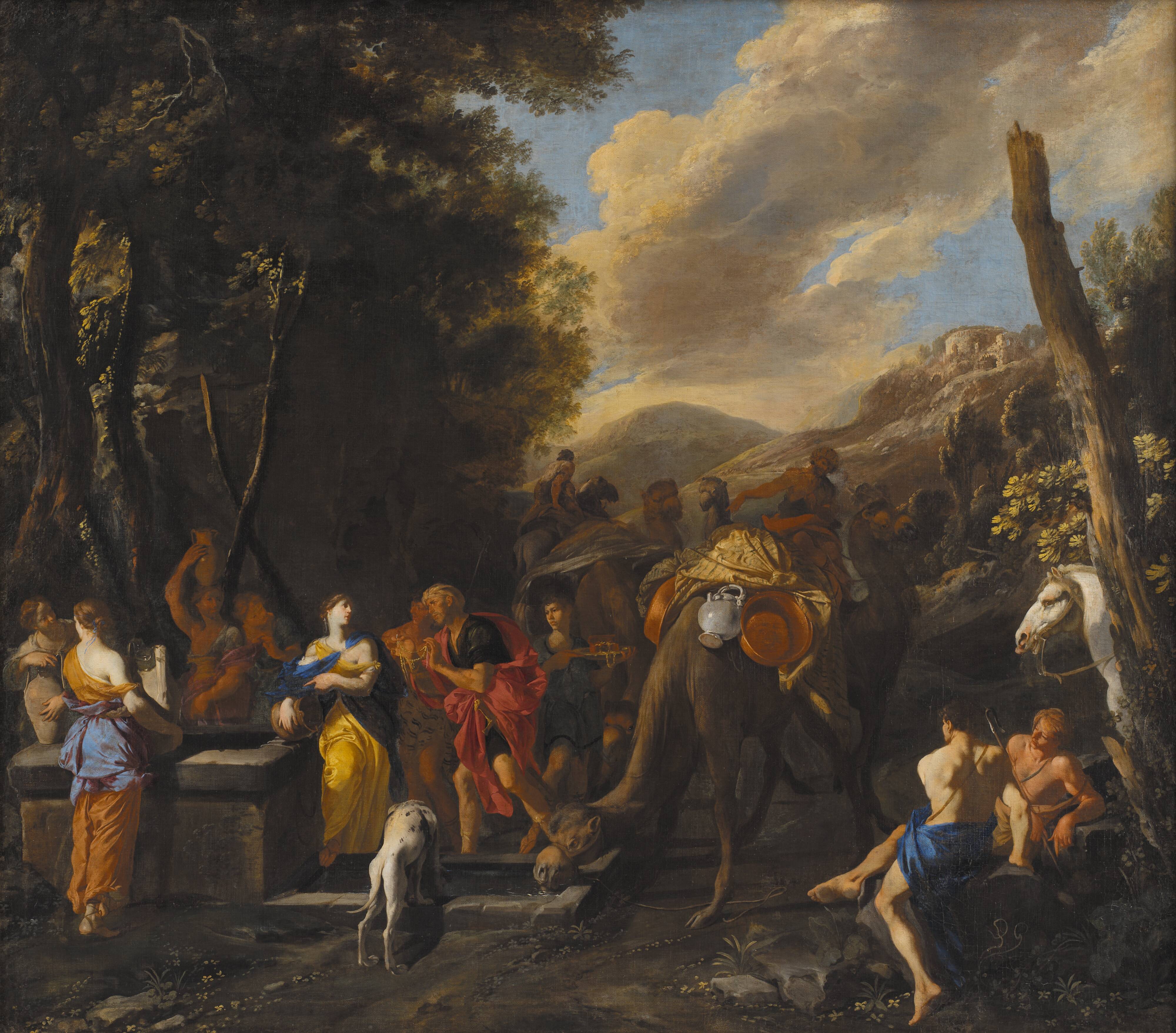
Rebecca and Eliezer at the Well
Domenico Gargiulo (Italian, 1609–1675)
earlier ascribed to Giovanni Benedetto Castiglione (Italian, 1609–1664)
1627-1679
- Medium
- Oil on canvas
- Classification
- Painting
- Dimensions
- height 135 cm, width 157 cm
- Culture
- Italian
- Museum
- SMK – National Gallery of Denmark
- Rights
- Public Domain Mark: SMK waives its rights in this photograph, as the museum states it.
- Who can see it
- Teens profiles and older: its museum says too little about what it shows to place it for younger viewers. How works are placed
View at the SMK – National Gallery of Denmark
About this work
Italian art has always occupied a space between the expressive and the classical. This is most clearly apparent in Naples where Domenico Gargiulo (1588-1656) represents the classically tinged school with references back to Antiquity. Characteristics of Gargiulo The statuesque calm of the figures, the clear composition with special emphasis on the horizontal and vertical lines, and the measured colour scheme are all characteristicof Gargiulo. His clients seem to have favoured this particular motif; we know of five different versions. The story behind the motif Genesis tells us how Abraham sent his bondsman Eliezer to his own country to find a bride for his only son, Isaac. As the evening drew close, Eliezer waited at the well outside of Nahor and decided to propose to the woman who would give both him and his camels water. Then Rebecca came out of the town bearing a pitcher on her shoulder. He asked her for water, and when she had fulfilled his wish, she poured water for his camels. Then Eliezer knew that he was the right bride for Isaac, gave her jewellery, negotiated with her relatives and brought her back to be the bride of Isaac.