Window mode follows your eyes with your camera, in this browser only: no picture or position leaves your device.
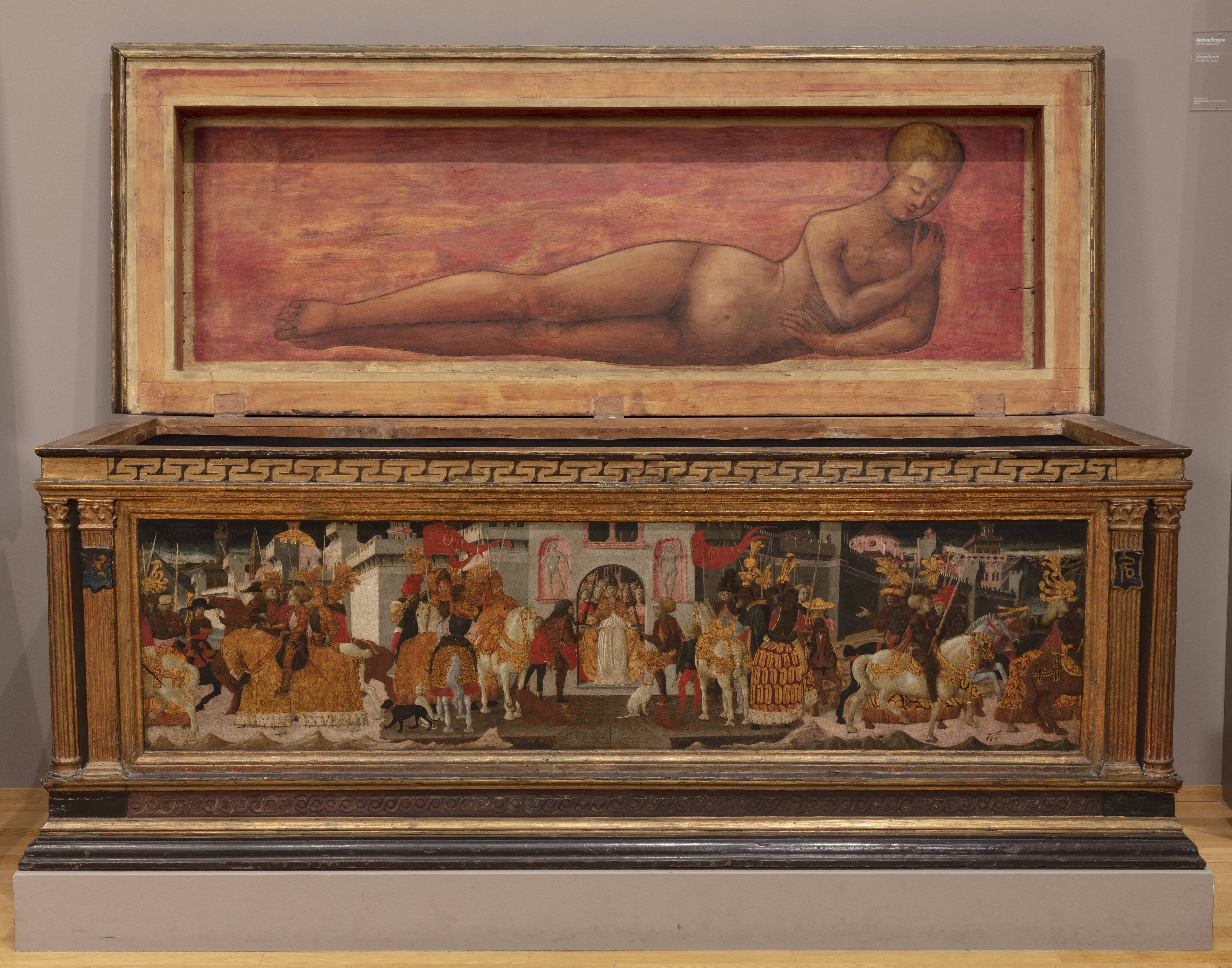
Nuptual Chest (Storage Chest). So-called "Cassone" or "Forziere"
attributed to Lo Scheggia (Giovanni di Ser Giovanni Guidi) (Italian, 1406–1486)
1450-1475
- Medium
- Tempera on panel
- Classification
- Cassone
- Dimensions
- height 41.5 cm, width 165 cm, height 86.8 cm, width 207.7 cm
- Culture
- Italian
- Museum
- SMK – National Gallery of Denmark
- Rights
- Public Domain Mark: SMK waives its rights in this photograph, as the museum states it.
- Who can see it
- Teens profiles and older: its museum says too little about what it shows to place it for younger viewers. How works are placed
View at the SMK – National Gallery of Denmark
About this work
In fifteenth-century Florence all affluent couples owned beautifully painted chests for clothes and accessories. On the day of their wedding, these nuptial chests were carried by a procession of people, moving them from the bride’s parents’ house to her new home, where they were placed in the sleeping quarters. The front of such chests were usually decorated by non-religious motifs. This example depicts a story from the early days of Rome. The Romans had abducted the women of a neighbouring tribe, the Sabines, because they needed wives, but the Sabines sought to reclaim their women. The front of this chest shows the Sabine women standing in the gates of Rome, led by Hersilia, who is holding two swords while her father, Tatius, king of the Sabines, and her husband Romulus, first king of Rome, both kneel down as they make peace.