Window mode follows your eyes with your camera, in this browser only: no picture or position leaves your device.
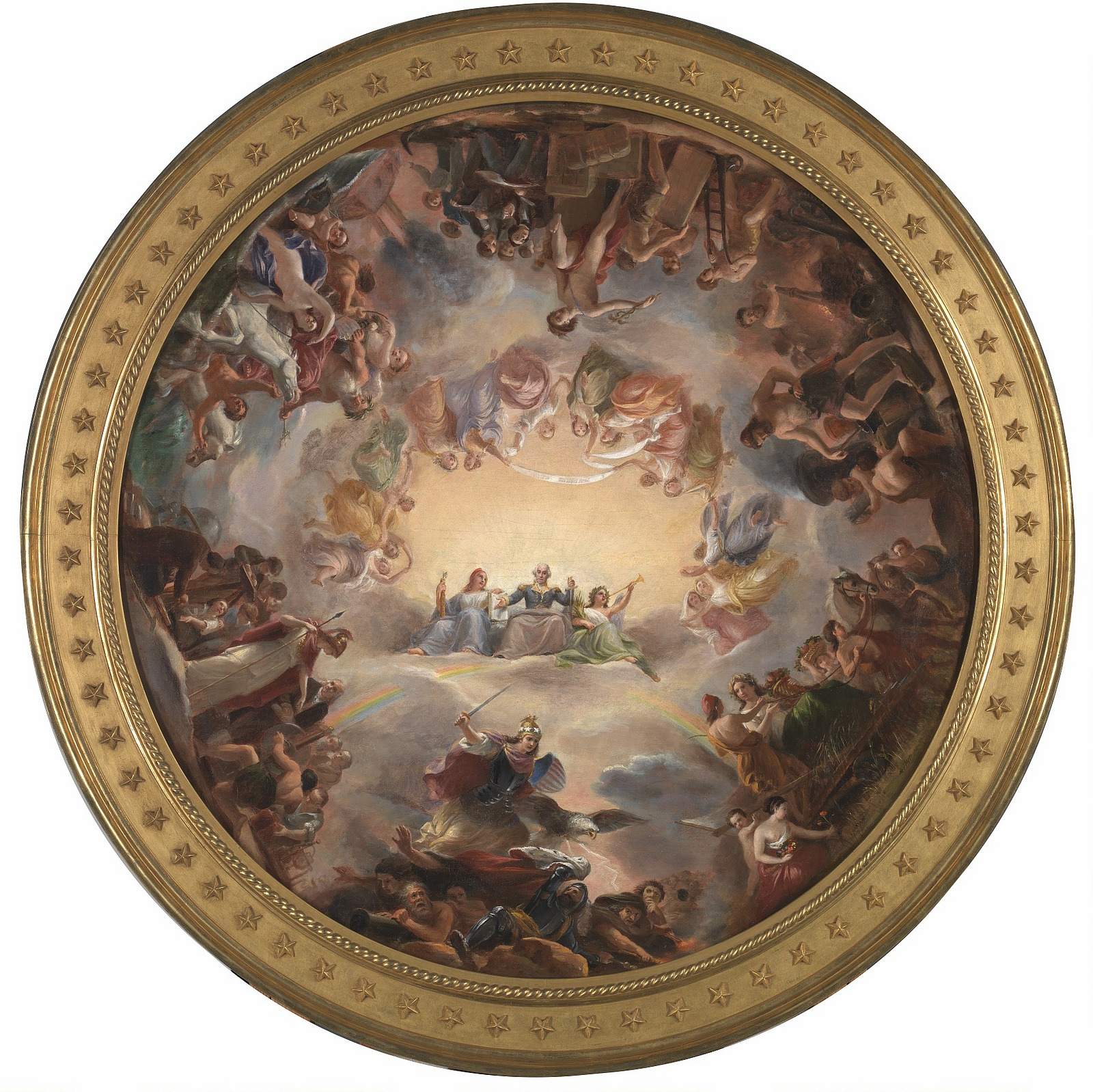
Study for the Apotheosis of Washington in the Rotunda of the United States Capitol Building
Constantino Brumidi (born Rome, Italy 1805-died Washington, DC 1880)
ca. 1859-1862
- Medium
- oil on canvas
- Classification
- Paintings
- Dimensions
- 35 1/4 in. (89.5 cm) diam.
- Museum
- Smithsonian Institution, Smithsonian American Art Museum, Painting and Sculpture
- Credit line
- Smithsonian American Art Museum, Museum purchase made possible by the American Art Forum
- Rights
- CC0 (Smithsonian Open Access), as the museum states it.
- Who can see it
- Teens profiles and older: its subject is for older viewers (war, death, the Passion, drink or the like). How works are placed
View at the Smithsonian Institution
About this work
Brumidi was commissioned to paint the ceiling decoration in the rotunda of the United States Capitol, and presented this study to gain approval to begin the monumental work. He chose to paint George Washington in the center of the dome, having ascended to the heavens, looking down upon the visitor. Steeped in classical mythology, Brumidi presents George Washington as Zeus, chief among the Greek gods, flanked by thirteen female figures representing the original thirteen colonies. Six vignettes form the outer edge of the decoration, with allegories pairing Greek gods and goddesses with an aspect of American prowess and ingenuity. Brumidi incorporated current events into his vignettes: at the bottom of this painting, Athena--portrayed as goddess of war--vanquishes the forces of evil, here portrayed by Jefferson Davis, president of the Confederacy, and his vice president, Alexander H. Stephens. The completion of the dome in 1865 came to symbolize a newly reunited America after the Civil War.