Window mode follows your eyes with your camera, in this browser only: no picture or position leaves your device.
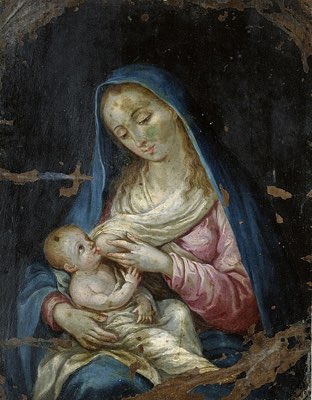
La Virgen del pilar
José Campeche y Jordán (born San Juan, Puerto Rico 1751-died San Juan, Puerto Rico 1809)
late 18th century
- Medium
- oil on canvas mounted to board
- Classification
- Paintings
- Dimensions
- 23 x 16 7/8 in. (58.4 x 42.9 cm.)
- Museum
- Smithsonian Institution, Smithsonian American Art Museum, Painting and Sculpture
- Credit line
- Smithsonian American Art Museum, Teodoro Vidal Collection
- Rights
- CC0 (Smithsonian Open Access), as the museum states it.
- Who can see it
- Tweens profiles and older: its subjects are known and suit older children. How works are placed
View at the Smithsonian Institution
About this work
Devotion to the Virgin is an important element of Puerto Rican Catholicism. The Madonna is venerated in many guises, each with its own iconography. According to Spanish legend, the apostle James, patron saint of Spain, saw a vision of the Virgin Mary one night while he was praying on the banks of the Ebro at Saragoza. Mary asked for a church to be built on that spot. The church, Santa Maria la Mayor, was erected along with a statue of the Virgin mounted on a marble pillar. By 1456, the term Virgen del Pilar was so common among Catholics that Pope Calixtus III confirmed the name by papal decree. (Yvonne Lange, "Santos: The Household Wooden Saints of Puerto Rico," PhD diss., 1975)