Window mode follows your eyes with your camera, in this browser only: no picture or position leaves your device.
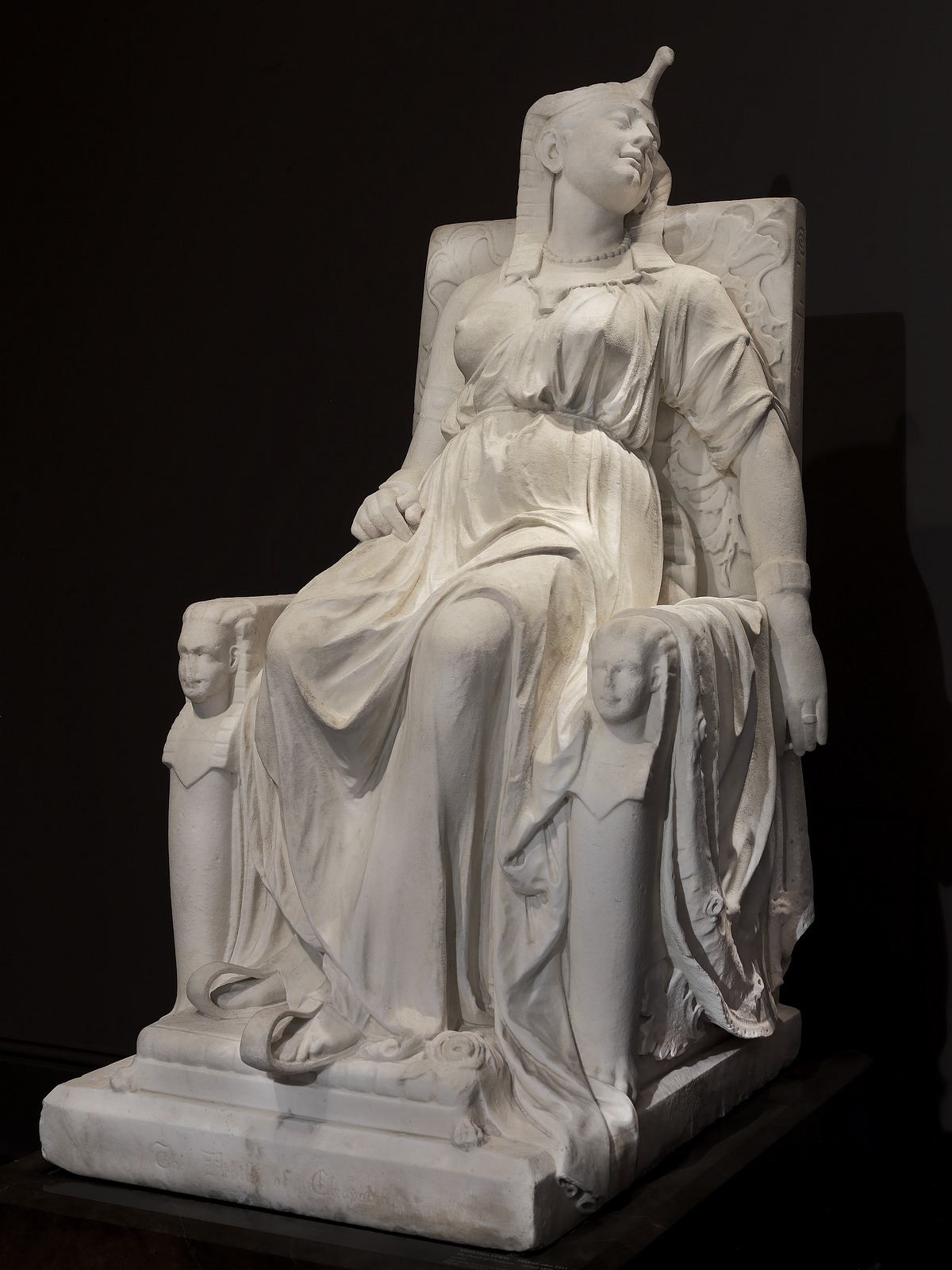
The Death of Cleopatra
Edmonia Lewis (born Greenbush (now Rensselaer), NY 1844-died London, England 1907)
carved 1876
- Medium
- marble
- Classification
- Sculpture
- Dimensions
- 63 x 31 1/4 x 46 in. (160.0 x 79.4 x 116.8 cm.)
- Culture
- Egyptians
- Museum
- Smithsonian Institution, Smithsonian American Art Museum, Painting and Sculpture
- Credit line
- Smithsonian American Art Museum, Gift of the Historical Society of Forest Park, Illinois
- Rights
- CC0 (Smithsonian Open Access), as the museum states it.
- Who can see it
- Adult profiles and older: its museum's description or title mentions nudity. How works are placed
View at the Smithsonian Institution
About this work
Cleopatra (69 - 30 BCE), the legendary queen of Egypt from 51 to 30 BCE, is often best known for her dramatic suicide, allegedly from the fatal bite of a venomous snake. Here, Edmonia Lewis portrayed Cleopatra in the moment after her death, wearing her royal attire, in majestic repose on a throne. The identical sphinx heads flanking the throne represent the twins she bore with Roman general Marc Antony, while the hieroglyphics on the side have no meaning. Lewis was working at a time when Neoclassicism was a popular artistic style that favored classical, Biblical, or literary themes—thus Cleopatra was a common subject. Unlike her contemporaries who often depicted an idealized Cleopatra merely contemplating suicide, Lewis showed the queen’s death more realistically, after the asp’s venom had taken hold—an attribute viewed as “ghastly” and “absolutely repellant” in its day (William J. Clark, Great American Sculpture, 1878). Despite this, the piece was first exhibited to great acclaim at the Centennial Exhibition in Philadelphia in 1876 and critics raved that it was the most impressive American sculpture in the show. Not long after its debut, however, Death of Cleopatra was presumed…