Window mode follows your eyes with your camera, in this browser only: no picture or position leaves your device.
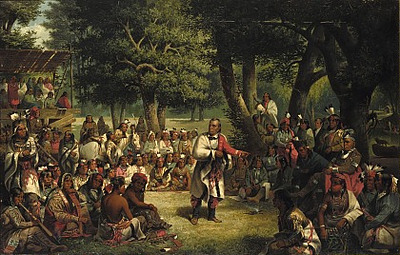
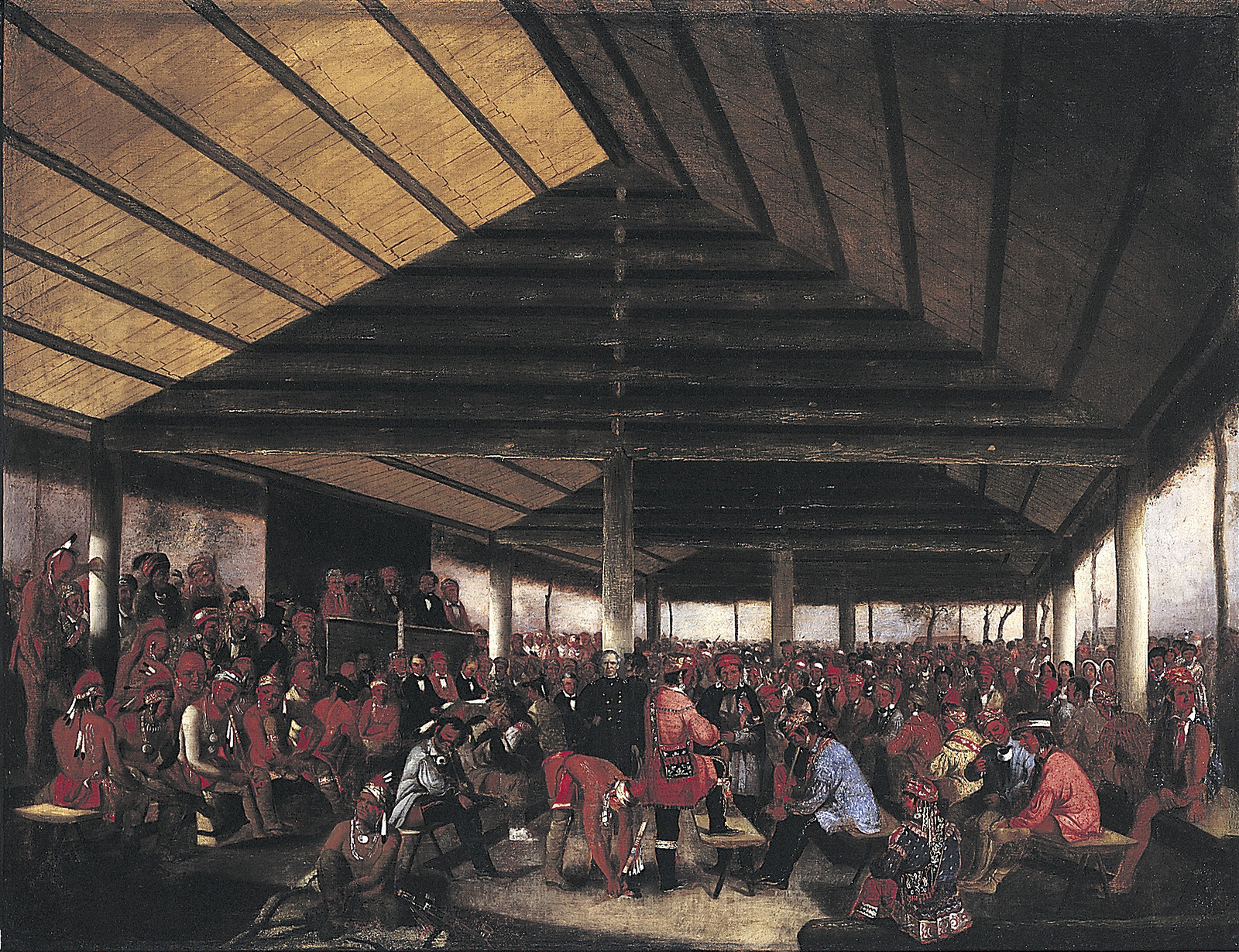
International Indian Council (Held at Tallequah, Indian Territory, in 1843)
John Mix Stanley (born Canandaigua, NY 1814-died Detroit, MI 1872)
1843
- Medium
- oil on canvas
- Classification
- Paintings
- Dimensions
- 40 1/2 x 31 1/2 in. (102.8 x 80.0 cm.)
- Culture
- Indians of North America
- Museum
- Smithsonian Institution, Smithsonian American Art Museum, Painting and Sculpture
- Credit line
- Smithsonian American Art Museum, Gift of the Misses Henry
- Rights
- CC0 (Smithsonian Open Access), as the museum states it.
- Who can see it
- Teens profiles and older: its subject is for older viewers (war, death, the Passion, drink or the like). How works are placed
View at the Smithsonian Institution
About this work
In the mid-nineteenth century, the United States government moved tribes from the Southeast to Indian Territory, which later became Oklahoma and Kansas. In 1843, Cherokee principal chief John Ross called a meeting of the tribes at Tallequah (also spelled Tahlequah) to “renew their ancient customs, and to revive their ancient alliances.” Hundreds of Native Americans attended, as did several United States government officials. John Mix Stanley was there, and a contemporary newspaper reported that the artist had with him a “Daguerreotype apparatus.” Stanley may have relied on the camera as the basis for the detailed portrait of Zachary Taylor, the gray-haired man in the center of the composition wearing a military frock coat and holding a palmetto hat. Taylor was the top-ranking government official at the meeting. (Schimmel, “John Mix Stanley and the Imagery of the West in the Nineteenth Century.” PhD diss., 1983)