Window mode follows your eyes with your camera, in this browser only: no picture or position leaves your device.
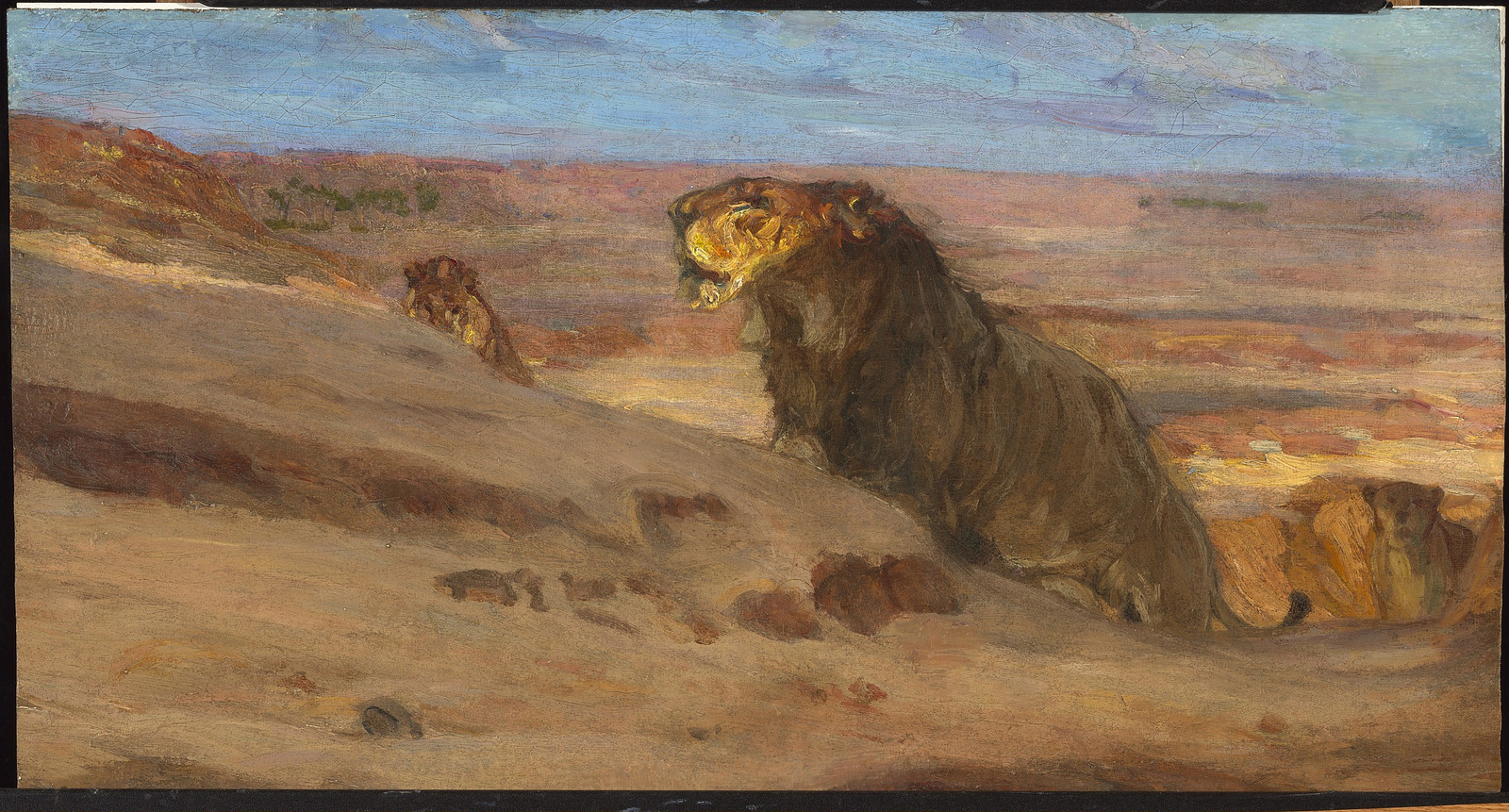
Lions in the Desert
Henry Ossawa Tanner (born Pittsburgh, PA 1859-died Paris, France 1937)
ca. 1897-1900
- Medium
- oil on canvas mounted on plywood
- Classification
- Paintings
- Dimensions
- 15 1/2 x 29 3/8 in. (39.5 x 74.5 cm.)
- Museum
- Smithsonian Institution, Smithsonian American Art Museum, Painting and Sculpture
- Credit line
- Smithsonian American Art Museum, Gift of Mr. and Mrs. Norman Robbins
- Rights
- CC0 (Smithsonian Open Access), as the museum states it.
- Who can see it
- Little Ones profiles and older: it shows gentle subjects for the very young. How works are placed
View at the Smithsonian Institution
About this work
Henry Ossawa Tanner grew up in a religious home and his family took special pride in the history of the biblical Hamatic races of African origin (Mosby, Henry Ossawa Tanner, 1991). It is possible that he regarded the lion as a symbol of his African heritage. Tanner learned to draw lions from trips to the zoo in Philadelphia, where he grew up and attended art school. While in Paris in 1891, he sketched them at the Jardin des Plantes and took an animal anatomy course at the natural history museum. Tanner painted Lions in the Desert during one of his visits to the Middle East, which he described as a barren landscape. He did not see actual lions there, but later added them to the painting in his studio.