Window mode follows your eyes with your camera, in this browser only: no picture or position leaves your device.
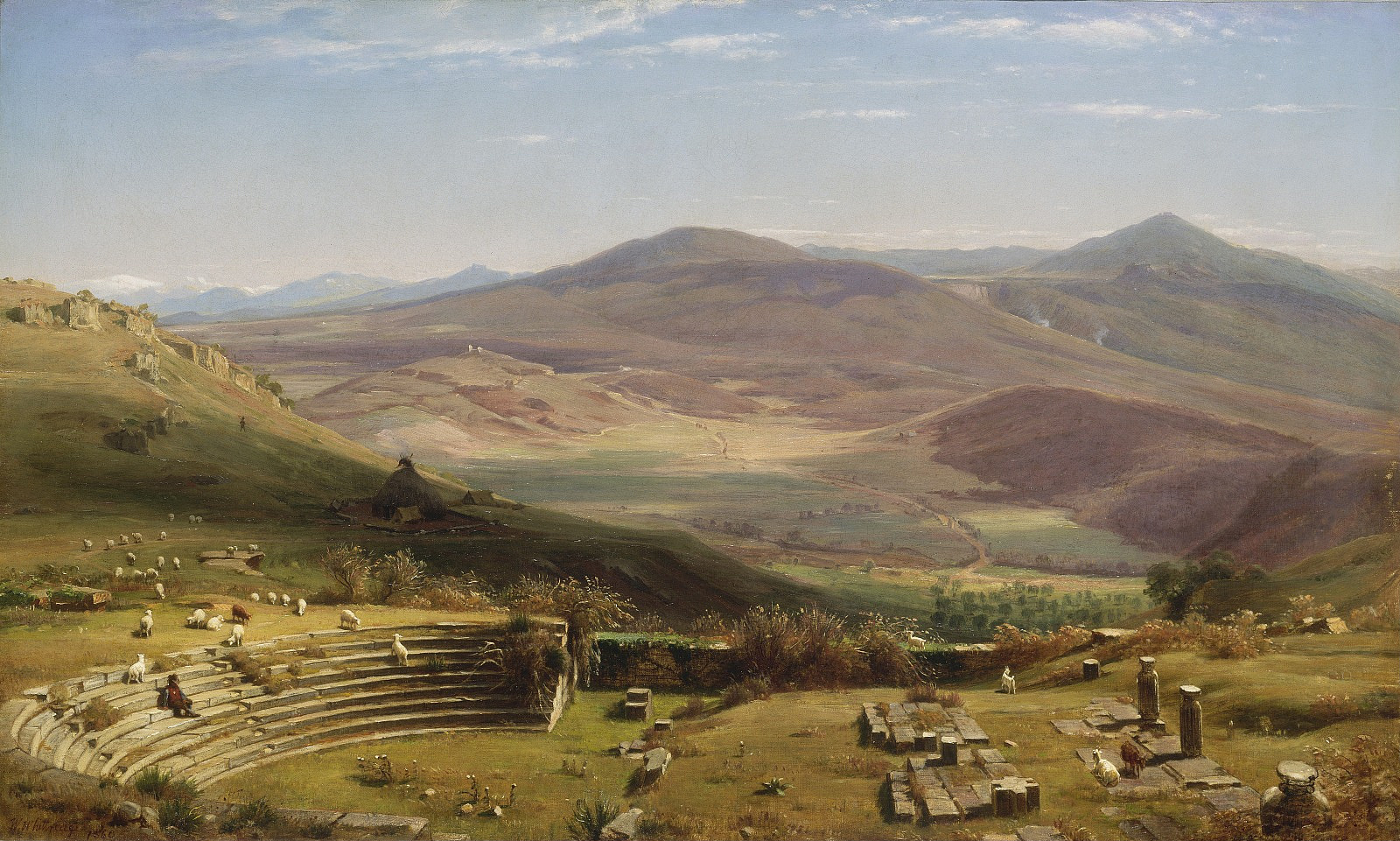
The Amphitheatre of Tusculum and Albano Mountains, Rome
Worthington Whittredge (born Springfield, OH 1820-died Summit, NJ 1910)
1860
- Medium
- oil on canvas
- Classification
- Paintings
- Dimensions
- 24 x 40 in. (61.0 x 101.6 cm.)
- Culture
- Alban Hills
- Museum
- Smithsonian Institution, Smithsonian American Art Museum, Painting and Sculpture
- Credit line
- Smithsonian American Art Museum, Museum purchase
- Rights
- CC0 (Smithsonian Open Access), as the museum states it.
- Who can see it
- Tweens profiles and older: its subjects are known and suit older children. How works are placed
View at the Smithsonian Institution
About this work
Worthington Whittredge was among many American artists who traveled to Europe in the nineteenth century. The ancient culture of Italy offered a poignant tale of faded glory that contrasted sharply with America's rise to economic and political power. Whittredge showed the ruins of the amphitheatre at Tusculum in the harsh light of day. Indolent shepherds nod off and goats graze where Rome's actors and playwrights once took their bows. A thatched hut and meager yard appear in the shadow of a cloud, signifying the poverty that struck American travelers as powerfully as the magnificent ruins. The United States stood on the threshold of the Gilded Age, when public art and architecture would follow the model of ancient Rome and Greece. But Italy's most important contribution to America would be its people, who immigrated to the United States by the hundreds of thousands, contributing their labor and culture to the nation's coming-of-age.Exhibition Label, Smithsonian American Art Museum, 2006