Window mode follows your eyes with your camera, in this browser only: no picture or position leaves your device.
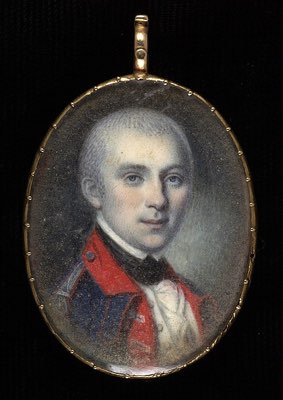
Le Duc de Liancourt
Charles Willson Peale (born Queen Anne's County, MD 1741-died Philadelphia, PA 1827)
ca.1794-1797
- Medium
- watercolor on ivory
- Classification
- Paintings
- Dimensions
- 1 5/8 x 1 3/8 in. (4.1 x 3.4 cm) oval
- Museum
- Smithsonian Institution, Smithsonian American Art Museum, Painting and Sculpture
- Credit line
- Smithsonian American Art Museum, Museum purchase
- Rights
- CC0 (Smithsonian Open Access), as the museum states it.
- Who can see it
- Tweens profiles and older: its subjects are known and suit older children. How works are placed
View at the Smithsonian Institution
About this work
A staunch advocate of the French Revolution, Liancourt (1747-1827) was considered the French equivalent to Benjamin Franklin. He was part of Lafayette’s entourage, and became friends with George Washington, as both men were farmers interested in new agricultural techniques. Nancy Shippen, a prominent Philadelphian, recorded his remark on American democracy: “In the days of my power, under the ancient régime of France, I had fifty servants to wait upon me, but yet my coat was never as well brushed as now that I do it myself.” Liancourt wrote a two-volume book titled Travels through the United States of North America, the Country of the Iroquois and Upper Canada in the years 1795, 1796, and 1797, in which he recorded his experiences. His published memoirs made him one of France’s most respected authors.