Window mode follows your eyes with your camera, in this browser only: no picture or position leaves your device.
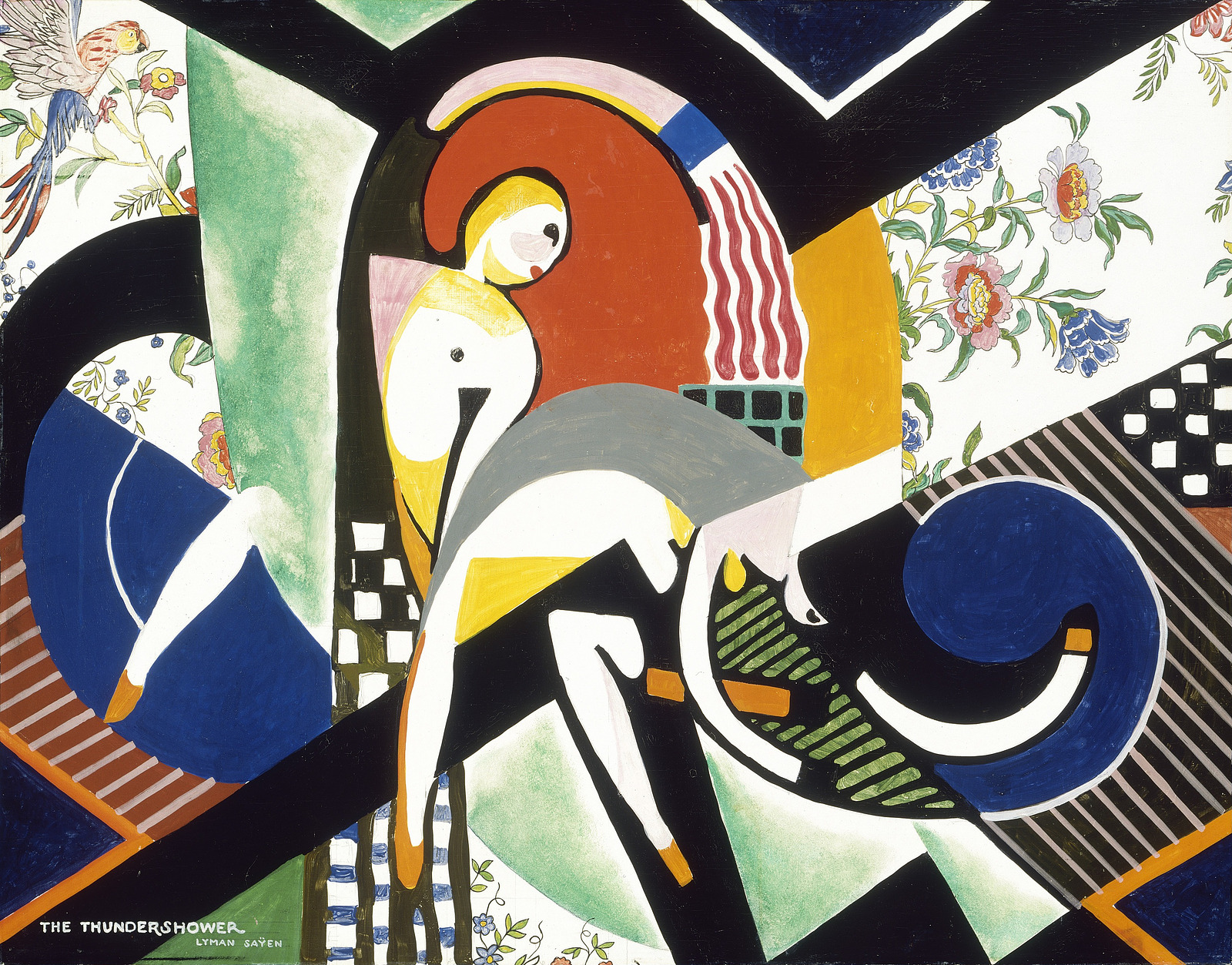
The Thundershower
H. Lyman Saÿen (born Philadelphia, PA 1875-died Philadelphia, PA 1918)
ca. 1917-1918
- Medium
- tempera on wood
- Classification
- Paintings
- Dimensions
- 36 x 46 in. (91.4 x 116.8 cm.)
- Museum
- Smithsonian Institution, Smithsonian American Art Museum, Painting and Sculpture
- Credit line
- Smithsonian American Art Museum, Gift of H. Lyman Sayen to his nation
- Rights
- CC0 (Smithsonian Open Access), as the museum states it.
- Who can see it
- Tweens profiles and older: its subjects are known and suit older children. How works are placed
View at the Smithsonian Institution
About this work
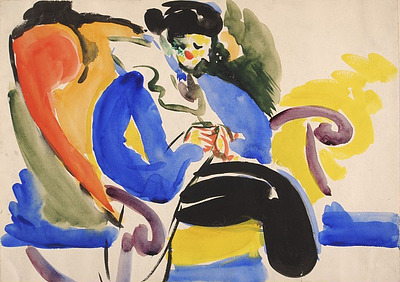
Saÿen studied with Matisse in Paris and was among the first to bring modern art into Philadelphia's conservative culture. He created The Thundershower from a mix of European modernism and Native American decorative patterns. But this painting is not just "cross-cultural." It also marks a transition from an older world to a new and dynamic century. The two figures move through time and space like the frames of a filmstrip, and organic forms meld with angles and arcs of pure color. Before he began to paint, Saÿen was an electrical engineer who held patents for radiological instruments. He died on the threshold of the Machine Age, shortly after completing this work, and The Thundershower suggests an artist who was already engaged in a new way of seeing.Exhibition Label, Smithsonian American Art Museum, 2006