Window mode follows your eyes with your camera, in this browser only: no picture or position leaves your device.
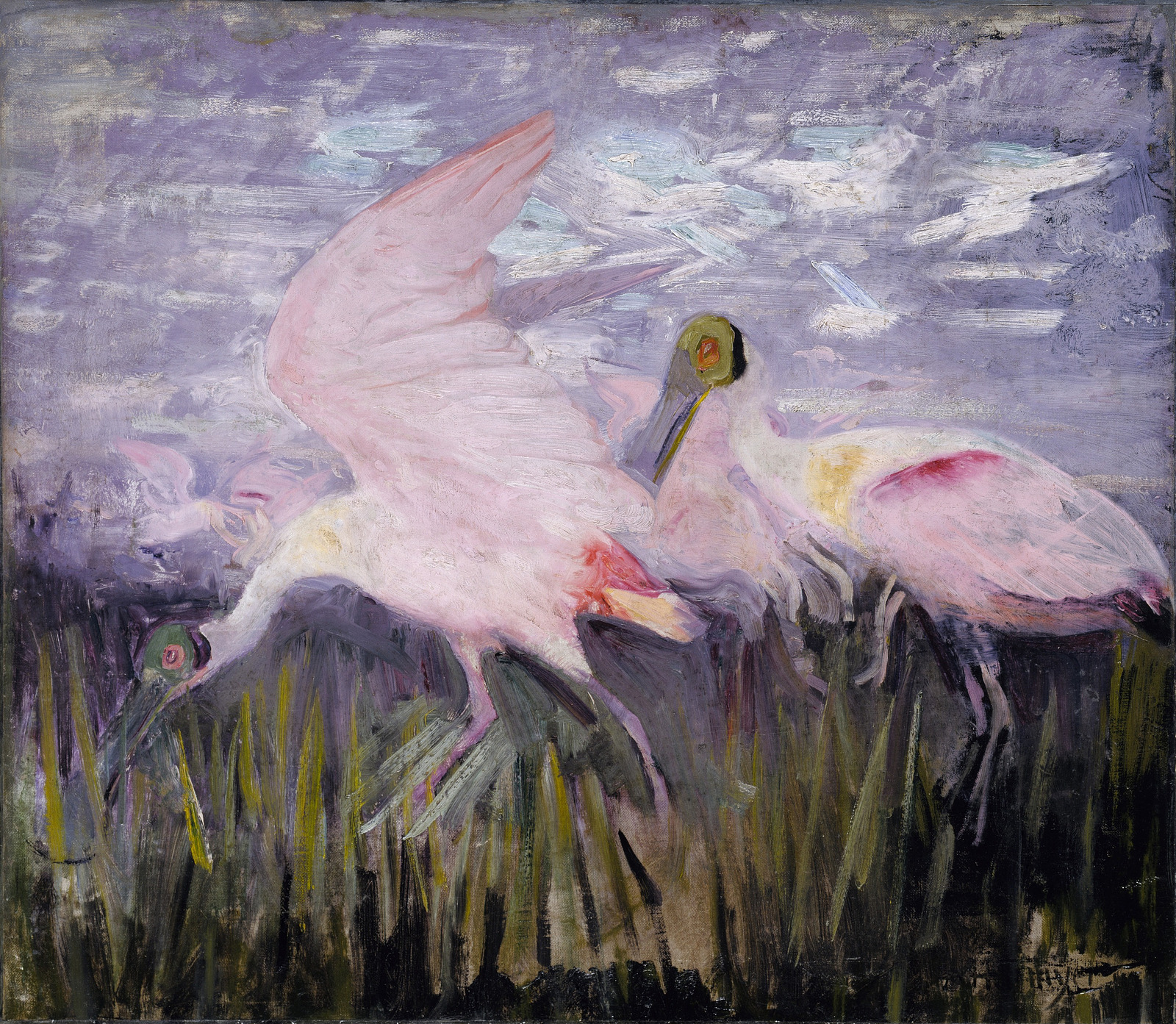
Roseate Spoonbills, study for book Concealing Coloration in the Animal Kingdom
Abbott Handerson Thayer (born Boston, MA 1849-died Dublin, NH 1921)
ca. 1905-1909
- Medium
- oil on paperboard
- Classification
- Paintings
- Dimensions
- 22 7/8 x 26 1/4 in. (58.2 x 66.6 cm.)
- Museum
- Smithsonian Institution, Smithsonian American Art Museum, Painting and Sculpture
- Credit line
- Smithsonian American Art Museum, Gift of the heirs of Abbott Handerson Thayer
- Rights
- CC0 (Smithsonian Open Access), as the museum states it.
- Who can see it
- Little Ones profiles and older: it shows gentle subjects for the very young. How works are placed
View at the Smithsonian Institution
About this work
In 1909, Abbott Handerson Thayer and his son, Gerald, published a controversial book titled Concealing Coloration in the Animal Kingdom, offering their theory of animal camouflage. Thayer believed that the coloration of animals, no matter how eye-catching, was meant to disguise them in nature through what he called "countershading." Even bright pink flamingoes would vanish against a similar colored sky at sunset or sunrise. No matter that at times their brilliant feathers were highly visible, their coloration would protect them from predators at crucial moments so that "the spectator seems to see right through the space occupied by an opaque animal."